Wise connects knowledge with sensible choices—and has some less literal conversational uses.
Understanding guides a sensible response
Understanding guides a sensible response
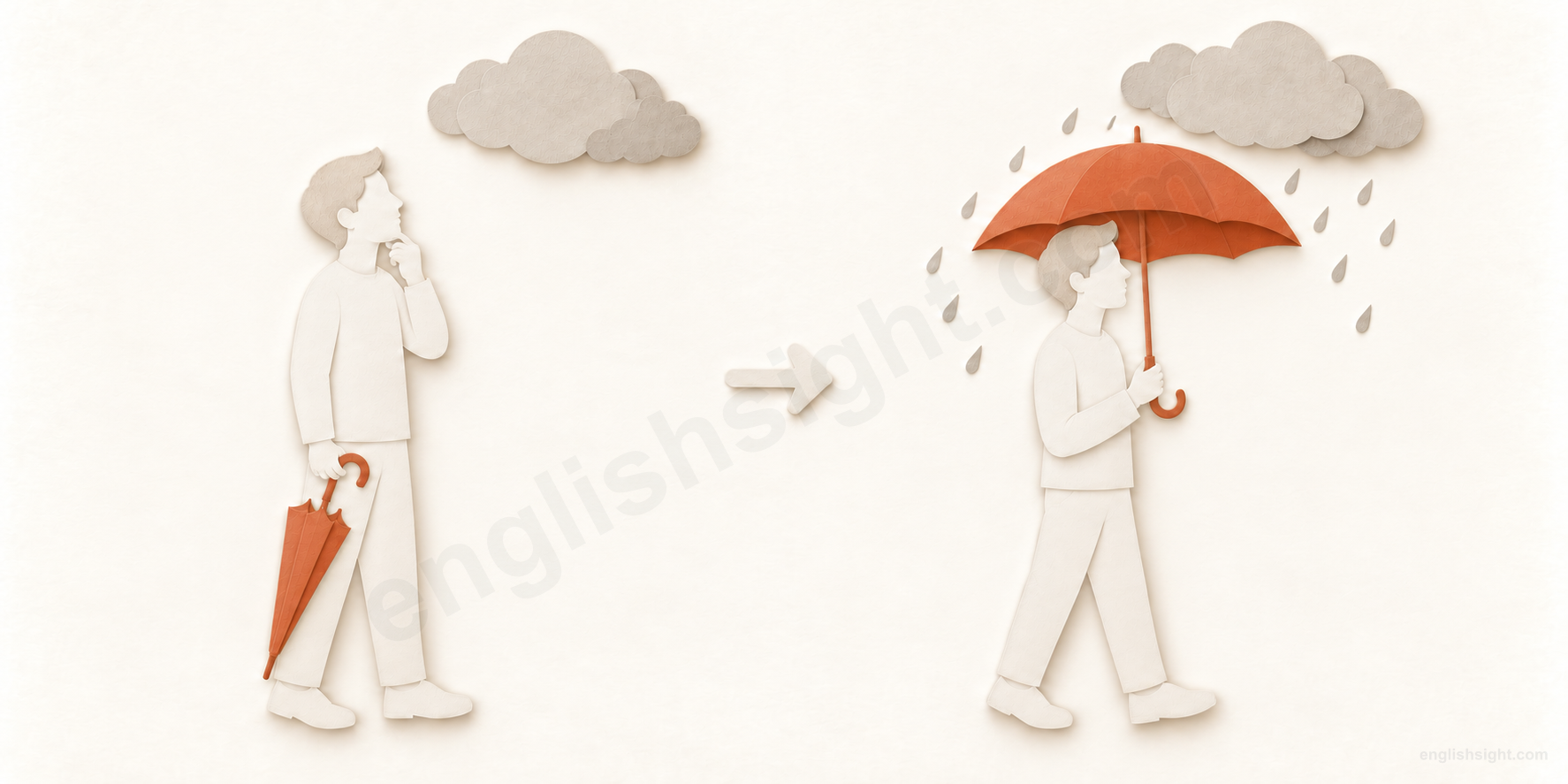
The person notices a rain cloud while holding a closed umbrella.
wise
The same person shelters under the opened umbrella as rain falls around it.
Understanding the warning guides a sensible choice: open the umbrella.
Wise links understanding with sensible judgment; here, noticing a rain cloud guides preparation.
Use what you understand about a situation to judge what is sensible before you act.
A person notices a rain cloud while holding a closed umbrella, then opens it as rain starts. The important relationship is between relevant information and a considered response. This teaching example does not define every wise action or guarantee a good outcome. Awareness idioms and slang need their own explanations.
Knowing many things and choosing well are different abilities. Wise usually focuses on how understanding or experience guides judgment.
Other patterns shift the emphasis to knowing what is really happening. Fixed expressions can also involve hindsight, warnings, or a disrespectfully clever manner.
01
People, choices, and advice
Wise usually praises how someone judges a situation or what they choose to do. Knowledge matters because of how it is used.
01
a wise + person; person + be + wise; wiser than; the wisest
a wise person
someone with good judgment
Situation / information
A friend asks how to handle a disagreement.
Judgment / response
An experienced listener gives thoughtful advice.
Wise concerns judgment, not just the number of facts someone knows.
A wise person understands situations and uses knowledge or experience to judge well. Wise can stand before a noun or after be: a wise friend; My friend is wise.
Intelligent often describes the ability to learn or reason; knowledgeable describes having information. Someone can be intelligent yet make an unwise choice. Calling a person wise usually praises their judgment.
The forms are wise /waɪz/, wiser, and wisest: She is wiser than she was last year. Age may bring experience, but wise does not mean old. Wise beyond her years praises judgment unusually mature for her age.
In a sentence
Our youngest colleague is wise enough to listen before offering advice.
Watch the difference Enough follows the adjective: wise enough, not enough wise. Wiser is the usual comparative, not more wiser.
They choose a practical plan with the consequences in mind.
Wise can describe the action, choice, or advice rather than the person.
A wise decision, choice, move, investment, or precaution is judged sensible in its situation. Wise words and wise advice offer sound guidance. A wise move may be a decision, not a physical movement.
The umbrella sketch illustrates thinking ahead: seeing a rain cloud matters because the person uses that information to prepare. Wise does not guarantee that the future will turn out well.
Use wisely to describe how someone acts: We used our time wisely. Use wise after a linking verb: That choice seems wise. Advice is uncountable: some wise advice, not a wise advice.
In a sentence
Keeping a copy of the agreement was a wise precaution.
Watch the difference A lucky result alone does not show that the original decision was wise.
03
it is / would be wise to + verb; someone is / would be wise to + verb
It would be wise to…
recommend a sensible action
Situation / information
You plan a journey with limited seats.
Judgment / response
A friend recommends booking ahead.
The infinitive names the action being evaluated.
It is wise to check evaluates checking as sensible. It would be wise to check often presents advice less directly; would need not introduce an explicit if-clause.
You would be wise to check addresses the person who should act. You were wise to check praises a choice already made. The subject is not becoming wise as a result of to check.
Put not before the infinitive to advise against an action: It would be wise not to rush. It would not be wise to rush also evaluates rushing negatively.
In a sentence
It would be wise to reserve our seats before Friday.
Watch the difference To introduces a verb here. Compare wise to the trick, where to introduces a noun phrase.
04
it + be + wise + of + person + to + verb
It was wise of you to…
praise someone’s judgment in doing something
Situation / information
You checked the address before leaving.
Judgment / response
Someone approves of that decision.
Of identifies whose judgment is being praised.
It was wise of you to check comments on you through the action you took. The first it is a grammatical placeholder; the action is supplied by to check.
Compare It is wise for us to leave now, which evaluates leaving now as sensible for us, with It was wise of you to leave, which explicitly praises your judgment. Of and for play different roles.
In a sentence
It was wise of you to ask whether the price included delivery.
Watch the difference Use of you when judging your behavior, not by you.
02
Knowing what is really happening
In these informal expressions, wise can concern awareness rather than good judgment. The construction tells you who finds out, who explains, or who remains unaware.
05
be / get wise to + person / thing
be / get wise to…
know or discover what is really happening
Situation / information
An offer looks unusually cheap.
Judgment / response
A customer notices the hidden charge.
Be describes awareness; get describes reaching it.
In this informal pattern, wise to a trick means aware of it, often because you have seen through an attempt to deceive you. I’m wise to his excuses says they no longer fool me.
Get wise to describes finding out. The pattern can also concern a trend or other facts, so dishonesty is a common context, not an absolute requirement.
Get supplies the change of state; wise is an adjective followed by to plus a noun phrase. This is different from the phrasal verb wise up.
In a sentence
Customers soon got wise to the extra fee hidden in the offer.
Watch the difference Wise to the fee means aware of it; wise to check the fee means sensible to check it.
06
wise up; wise up to + noun / the fact that + clause
wise up (to something)
stop being unaware of the reality of a situation
Situation / information
You keep trusting an unreliable promise.
Judgment / response
You finally recognize the pattern.
Wise up presents a change in awareness, often about an unpleasant truth.
Wise up is an informal phrasal verb: She finally wised up. Add to to name the situation: She wised up to the problem. The change can lead someone to act more sensibly.
Wise up! can be a blunt demand to stop being naive. It is stronger and less neutral than Please look into this. Up belongs to the established expression; it does not mean upward movement.
As a verb it takes ordinary forms: wises up, wised up, wising up. She is wising up describes a developing realization; this is distinct from the adjective in She is wise.
In a sentence
I finally wised up to the fact that those messages were automated.
Watch the difference Do not omit up when using this phrasal verb: wised up to the problem.
07
wise + someone + up + about / to + something; put + someone + wise + to + something
wise someone up / put someone wise
give someone useful or inside information
Situation / information
A new worker does not know the real procedure.
Judgment / response
An experienced colleague explains it.
The person receiving information is the object.
To wise someone up is to make them aware of something. This informal transitive use has a different participant structure from She wised up: another person supplies the information.
With a pronoun, put it before up: wise me up, not wise up me. About or to can introduce the topic. Put someone wise to something is another informal way to say inform someone; keep the person between put and wise.
Neither expression is the ordinary neutral choice for every classroom lesson. Tell someone about it or explain it is often simpler.
In a sentence
A colleague wised me up about the booking system.
Watch the difference In put me wise, wise is a complement describing the informed state; this is not the particle verb wise up.
08
be + none the wiser; not be + any the wiser
be none the wiser
still fail to understand after receiving information
Situation / information
You watch a complicated demonstration.
Judgment / response
You still do not understand the process.
There has been no gain in understanding.
I’m none the wiser can mean that an explanation has not helped me understand. Wiser here concerns being better informed, not being a morally better or more sensible person.
I’m not any the wiser gives the same negative idea. None already supplies the negative meaning, so the standard expression is I’m none the wiser, not I’m not none the wiser. Learn the whole fixed comparative phrase.
In a sentence
After watching the demonstration twice, I was still none the wiser.
Watch the difference Do not replace the fixed the with a: none the wiser, not none a wiser.
09
no one / nobody + be + any the wiser; someone + be + none the wiser about + noun
no one will be any the wiser
nobody will find out what happened
Situation / information
Someone makes a small change without announcing it.
Judgment / response
Other people do not notice the change.
The missing knowledge concerns an event, not a failed explanation.
No one will be any the wiser can mean that nobody will discover an action or change. It often occurs in talk about concealing something, though the event need not be serious.
You can also say She was none the wiser about the change. Context distinguishes this from remaining confused after an explanation: here she simply did not know what had happened.
In a sentence
We replaced the broken mug with an identical one, and nobody was any the wiser.
Watch the difference Nobody already makes the clause negative; any fits here. The phrase does not say nobody is intelligent.
03
Warnings, hindsight, and sharp replies
Learn these expressions as whole units. Some build on sensible judgment; others concern a knowing or disrespectful manner.
10
be wise after the event
be wise after the event
know what should have been done only once the result is known
Situation / information
A plan fails in an unexpected way.
Judgment / response
A critic says the failure should have been obvious.
Hindsight supplies knowledge unavailable or unused at the time.
It’s easy to be wise after the event points out how easy it is to judge a past decision once you know the outcome. It often criticizes an unfair hindsight judgment.
This does not mean that every later lesson is useless. It questions how much credit someone deserves for a prediction made only after the result.
In a sentence
It’s easy to be wise after the event, but nobody predicted the power cut.
Watch the difference After the event is part of the established expression; it does not simply praise wisdom gained at a social event.
11
a word to the wise: + advice / warning
a word to the wise
introduce a useful warning or piece of advice
Situation / information
You know a venue has a strict entrance rule.
Judgment / response
You give a friend a brief warning.
The phrase announces advice; it does not test the listener’s intelligence.
A word to the wise commonly introduces a recommendation or warning. It can sound friendly, knowing, or slightly pointed, depending on tone.
The wise means wise people as a group. Word here is a short message, not necessarily a single written word. The expression alludes to the idea that a sensible person needs only a hint.
In a sentence
A word to the wise: bring a photo ID to the concert.
Watch the difference This can sound patronizing if used as though the listener should already know better.
12
be + penny-wise and / but pound-foolish
penny-wise and pound-foolish
save a little while overlooking a much larger cost
Situation / information
A company avoids a small maintenance expense.
Judgment / response
A later breakdown costs much more.
A narrow saving can be poor judgment overall.
This saying criticizes care with small sums combined with carelessness about larger costs. A small saving now may create a large expense later.
Both penny-wise and pound-foolish and penny-wise but pound-foolish occur. The British money terms express a contrast in scale; the criticism can apply wherever the spending happens.
In a sentence
Skipping routine maintenance to save a little money is penny-wise and pound-foolish.
Watch the difference This is criticism, not straightforward praise for being careful with money.
13
get wise with + person; a wise guy
Don’t get wise with me.
tell someone to stop being disrespectfully clever
Situation / information
Someone answers an instruction with a sarcastic remark.
Judgment / response
The other person objects to the attitude.
Here wise describes an impudent manner, not sound judgment.
In this mainly American slang use, getting wise means behaving in a cheeky or disrespectful way. Don’t get wise with me is a confrontational warning, not an invitation to learn.
A wise guy can similarly mean a person who acts as though they know more than everyone else, especially in North American informal speech. It is usually disapproving, unlike a wise person. Context may allow a joking tone.
In a sentence
“Don’t get wise with me,” the supervisor said after the sarcastic reply.
Watch the difference Compare get wise to the trick: to introduces what is discovered; with me names the person being treated disrespectfully.
14
crack wise
crack wise
make joking or witty remarks
Situation / information
A meeting is tense.
Judgment / response
Someone starts making jokes.
The humor belongs to this fixed expression.
Crack wise is an informal expression meaning make jokes. It can describe amusing comments or unwelcome joking, depending on the situation.
The verb is crack, so the past form is cracked wise. The expression does not mean breaking wisdom into pieces, and it is not a general rule that wise means funny.
In a sentence
He kept cracking wise while we were trying to discuss the delay.
Watch the difference Crack wise and give wise advice describe different kinds of speaking.
Keep the meaning and the construction together
Judgment, intelligence, and information
Wise usually concerns judgment. Intelligent concerns mental ability; knowledgeable concerns information. Informal wise to and none the wiser can focus on awareness instead. These meanings overlap but are not interchangeable in every sentence.
Adjective, adverb, and verb
Wise is normally an adjective; wisely describes an action. The noun is wisdom. The informal verb is used chiefly in wise up, including its transitive form. Do not invent a regular family of wise down, wise off, or other particle verbs.
The suffix is a separate branch
The ending -wise in clockwise or lengthwise concerns direction or manner; in money-wise it can mean regarding money. It is historically associated with a word for manner, not a rule that adds good judgment. Streetwise and worldly-wise, by contrast, describe practical understanding. These compounds are signposts, not a full word-building lesson.
Coverage boundary
This lesson covers the main modern judgment and awareness uses and selected established sayings. General dictionaries also record wise meaning learned or shrewd/crafty; those uses are not separately developed here and should not all be treated as praise for sound judgment. The lesson does not expand the archaic noun meaning manner, magical senses, regional Scottish verbs, names, or the religious title the Wise Men. The Mafia sense of wise guy is outside the everyday attitude comparison here.
Choose the meaning in context
Read the full pattern and the situation. Wise does not always praise a decision.
1. A friend recommends booking early. Which sentence gives that advice?
2. The explanation has finished, but you still do not understand. Which reply fits?
3. A colleague gave you inside information. Which pronoun position is standard?
4. Someone criticizes a failed plan using facts known only afterward. Which response challenges that hindsight?
5. Someone says Don’t get wise with me after a sarcastic answer. What do they mean?
Sources and teaching notes
The sources support the usage distinctions below. Explanations and examples are original. The umbrella diagram is a teaching model for informed judgment, not a literal definition of wise.
This picture illustrates one useful connection; it is not a mental image shared by every native speaker.