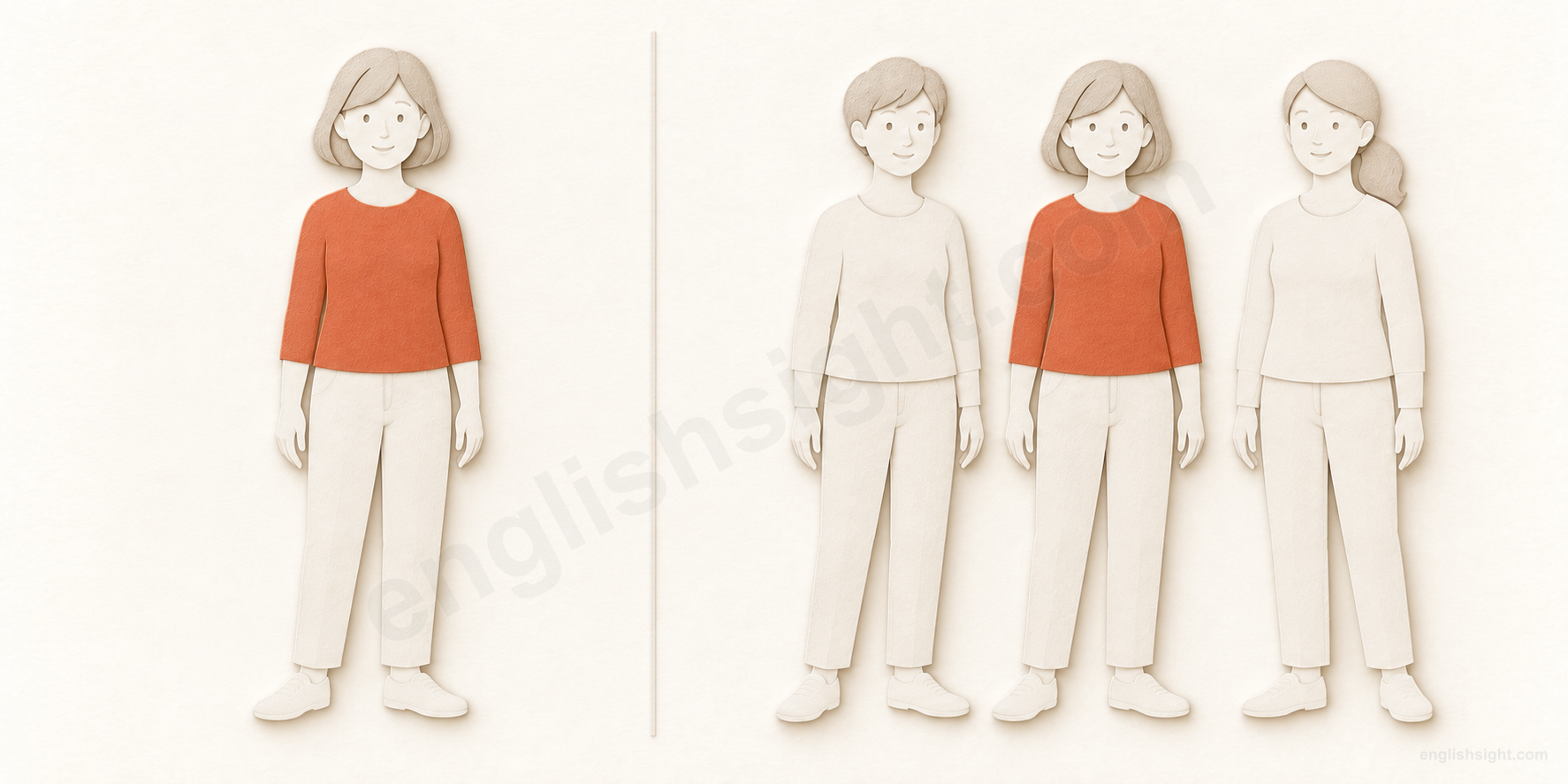
Woman names an adult female person; context adds age, number, work, relationships and evaluation.
One person, or people in a group
One person, or people in a group
One adult: a woman.
woman
Three adults: women.
One adult female person is a woman; several are women.
One woman, several women: the divider compares number, not a change of age or identity.
Woman identifies an adult female person. Use women for more than one; add other words to describe the person or the relevant connection.
This is a person category, not an action or a required life story. Clothing, hairstyle, work and personality do not define the word. The picture illustrates number; it cannot explain every idiom.
Start with a person: a woman. Adjectives and surrounding phrases tell us which woman we mean, what she does, or how she relates to someone. Woman itself does not name a job, a personality or a marital status.
The plural women changes both spelling and pronunciation. Some longer expressions are transparent descriptions; others, such as a woman of her word, have established meanings to learn as a whole.
01
People, age, number and belonging
Start with the ordinary person noun. Articles, descriptions, plural forms and possessives tell us who or how many we mean.
01
a / the / this + woman; the woman + description / who-clause
a woman / the woman
refer to an adult female person
Situation
An adult visitor arrives; you do not yet know her name.
What the expression says
You introduce her, then identify which visitor you mean.
Woman identifies a person, not her marital status or job.
Use a woman when introducing one person and the woman when the listener can identify her. A description can do the identifying: the woman by the door or the woman who called yesterday.
Woman is an ordinary, neutral person noun. It does not itself mean wife, mother, or employee. A sentence such as She is a woman still needs a before the singular countable noun.
In a sentence
A woman called earlier; the woman who called left this number.
Watch the difference Say She is a woman, not She is woman. Woman alone does not tell you whether she is married.
02
a + young / older / grown + woman
a young woman / a grown woman
describe a woman’s age or adult status
Situation
You describe someone’s stage of life.
What the expression says
An adjective narrows the age description.
Young can describe an adult; grown emphasizes adulthood.
A young woman is an adult who is relatively young; an older woman is further along in life. Grown woman emphasizes that the person is an adult, often when her independence matters.
Girl normally refers to a female child. Friends sometimes use girls informally about adult women, but calling an adult colleague a girl can sound dismissive. Woman is a useful neutral choice when adulthood is relevant.
In a sentence
Maya is a grown woman and can choose where she lives.
Watch the difference Young woman does not mean a small child. Grown woman concerns adulthood, not height.
03
one woman + singular verb; two / several women + plural verb; women + plural verb
one woman / two women / women in general
count women or discuss women as a group
Situation
You move from one person to several, or to a general statement.
What the expression says
The noun changes to women and takes plural agreement.
Woman and women differ in spelling and pronunciation.
The plural is women, not womans. Say woman /ˈwʊmən/ and women /ˈwɪmɪn/: the first vowel changes too. Compare One woman is waiting with Two women are waiting.
With women in general, an article is usually unnecessary: Women work in every department here. The women refers to a particular identifiable group. Some formal or older writing uses singular woman collectively for women as a whole; ordinary modern statements usually use women.
In a sentence
Three women are joining the training session tomorrow.
Watch the difference Use women are, not women is. Do not pronounce the first syllable of women like woman.
04
woman’s + noun; women’s + noun
a woman’s bag / women’s clothes
mark possession or an association with women
Situation
A bag belongs to one woman; a shop also has clothing for women.
What the expression says
The apostrophe distinguishes possession or association from a plain plural.
Women is already plural, so its possessive adds ’s.
A woman’s bag is a bag belonging to one woman. Women’s bags may mean bags belonging to several women or a type of bag sold for women; context supplies the relationship.
Use women’s in women’s clothes, women’s rights and the women’s team. These do not all describe literal ownership: the clothes are intended for women, the rights concern women, and the team is a women’s sporting category. The plain plural women has no apostrophe.
In a sentence
The shop moved its women’s clothes to the first floor.
Watch the difference Write women’s, not womens or womens’. The singular possessive woman’s refers to one woman.
05
a woman of colour / color; women of colour / color
a woman of colour / women of color
use an established racial identity term
Situation
A report discusses representation across racial backgrounds.
What the expression says
It uses a term for women who do not identify as white.
The whole phrase is a social identity term.
Woman of colour, spelled woman of color in American English, refers to a woman who does not identify as white. The plural is women of colour / color. The term is especially associated with US discussions and does not name one specific ethnic background.
Use a person’s own description when that is known and relevant. Do not rearrange the phrase into coloured woman: that has a different history and can be offensive.
In a sentence
The festival invited women of color to discuss their work as directors.
Watch the difference Colour / color is a British–American spelling difference; keep of in this expression.
02
Work, background and interests
Words next to woman can identify a job, connection or preference. Some combinations are established compound words; others are ordinary noun phrases.
06
a woman + occupation; women + plural occupation; female + occupation
a woman doctor / women doctors
specify that the person doing a job is a woman
Situation
A patient asks about the available doctors.
What the expression says
The description makes the doctor’s gender relevant.
Doctor names the occupation; woman supplies an extra description.
A woman doctor is a doctor who is a woman. In the plural, both parts change: women doctors. Female doctor / female doctors is another grammatical choice.
Usually doctor, engineer or writer is enough when gender is irrelevant. Woman is a noun used as a modifier here, not a prefix you can attach to every job. Compare women doctors, who are people, with women’s health, a field concerning women.
In a sentence
The clinic has two women doctors available this afternoon.
Watch the difference Use two women doctors, not two woman doctors or two women’s doctors when describing who the doctors are.
The beginning supplies the role; the ending identifies the person as a woman.
Businesswoman and spokeswoman are established words. A businesswoman works in business; a spokeswoman speaks for an organization. Their plurals are businesswomen and spokeswomen, with the same woman–women vowel change.
Learn the spelling of each compound rather than inventing forms freely. Neutral alternatives include businessperson and spokesperson. Police officer and chair are also useful role words when gender need not be stated.
In a sentence
A company spokeswoman confirmed the opening date.
Watch the difference The plural of spokeswoman is spokeswomen. A spokeswoman represents the organization; she is not simply any woman who speaks.
08
place / institution + woman; organization’s / our + woman + in + place
a London woman / an Oxford woman / our woman in…
identify a place, institution or representative connection
Situation
A report needs to identify someone by a relevant connection.
What the expression says
The place or organization supplies that connection.
The relationship is supplied by context, not by woman alone.
A London woman can mean a woman from London. An Oxford woman can mean a woman who studied at Oxford University. These phrases require context: a place name does not always identify birthplace.
An organization’s woman, or our woman in a city, can refer to its representative there, especially in journalism. A woman from the company is a more explicit everyday description. This is different from calling someone my woman as a partner.
In a sentence
Our woman in Rome will send a report after the meeting.
Watch the difference Do not assume Oxford woman always means born in Oxford; it may identify university membership.
09
be a + interest / preference + woman
a coffee woman / an outdoors woman
describe a woman by a strong preference or interest
Situation
Friends compare what they enjoy.
What the expression says
A noun or activity before woman presents a personal preference.
This conversational pattern describes the person, not a new kind of woman.
In informal conversation, I’m a coffee woman means coffee is my usual preference, perhaps rather than tea. An outdoors woman enjoys outdoor activities. Other combinations depend on a context that makes the preference clear.
The preference meaning belongs to the combination. A coffee woman could also be a woman selling coffee in a different context. For an unambiguous answer, say I prefer coffee or I enjoy being outdoors.
In a sentence
I’m a coffee woman, but I’ll have tea if that’s easier.
Watch the difference This is informal and context dependent; it is not a rule that any noun before woman means likes that thing.
10
a + number-woman + noun; number + women
a one-woman show / a four-woman team
describe how many women perform or do the work
Situation
You describe a performance or a team.
What the expression says
The number and woman form a modifier before the main noun.
The compound describes the main noun; woman stays singular inside it.
In theatre, a one-woman show has one female performer. In art, a one-woman show is an exhibition of one woman’s work. A one-woman business is run by one woman, and calling an operation a one-woman show can emphasize how much one person does.
A four-woman team has four women. Number–woman combinations stay singular and are hyphenated before the noun. Compare a four-woman team with The team has four women.
In a sentence
She wrote and performed a one-woman show about her travels.
Watch the difference Write a four-woman team, not a four-women team. A women’s team does not specify the number of members.
03
Relationships, conversation and forms of address
Context can give woman a partner meaning or make a phrase personal, candid or rude. These uses need more than the basic person label.
11
possessive + woman; the woman in + possessive + life
his woman / the woman in her life
refer to a female romantic partner in context
Situation
A conversation concerns someone’s romantic relationship.
What the expression says
Woman can refer to the partner rather than any female acquaintance.
The relationship context gives the noun its partner meaning.
The woman in someone’s life can mean their female romantic partner. In a different sentence, the women in my life could include relatives, friends and colleagues; the full context matters.
Some speakers use my woman or his woman for a wife or girlfriend. This is informal and can sound possessive or disapproving in context. My partner, my wife or my girlfriend makes the relationship clearer and is often a better everyday introduction.
In a sentence
The woman in her life is a musician she met last year.
Watch the difference Woman alone does not mean wife, and a possessive does not automatically mean a romantic relationship.
12
be / play / describe someone as + the other woman
the other woman
refer to the woman involved with someone who already has a partner
Situation
A story describes a person with an existing partner and another relationship.
What the expression says
The phrase identifies the woman in that additional sexual relationship.
The relationship meaning is established, but the same words can also be literal.
In a relationship story, the other woman is the woman someone is having a sexual relationship with while already having a wife or partner. The label can carry blame, so use it carefully about real people.
Elsewhere, the other woman may simply identify the second of two women: One woman wore a blue coat; the other woman wore a green one. Context determines whether there is any relationship meaning.
In a sentence
In the drama, she discovers that she is the other woman.
Watch the difference Another woman is not automatically the other woman in the relationship sense.
13
talk + woman to woman; a woman-to-woman + chat / conversation
woman to woman / a woman-to-woman talk
present a candid conversation between two women
Situation
Two women want to discuss something openly.
What the expression says
The phrase frames their conversation as direct and personal.
The expression adds a tone of frankness, not just the number of speakers.
Talk woman to woman presents a frank conversation between two women, often about something personal. Before a noun, write a woman-to-woman conversation or a woman-to-woman chat.
The speaker is appealing to a connection between the participants. It does not mean all women share the same experiences, and not every conversation between women needs this label.
In a sentence
Can we talk woman to woman about what happened yesterday?
Watch the difference Woman to woman does not mean from one woman through an intermediary; it describes how they talk.
14
woman as a direct address; my good / dear woman
“Woman, …” / “my good woman”
recognize a form of address that can offend
Situation
A speaker refers directly to the person being addressed.
What the expression says
Woman used as a vocative can sound angry or commanding.
A neutral noun for referring to someone is not automatically a polite way to address her.
The woman at reception is a neutral reference. Listen, woman! directly addresses the listener and commonly sounds impatient or insulting. Recognize it in dialogue, rather than using it to attract a stranger’s attention.
My good woman and my dear woman occur in older British speech and writing. They may sound friendly in context, but can also imply superiority. Excuse me or the person’s name is a safer everyday way to begin speaking.
In a sentence
The angry character shouts, “Listen, woman!”
Watch the difference Use Excuse me to get someone’s attention politely; adding my good does not guarantee politeness.
04
Established descriptions and idioms
Learn these expressions as complete patterns. Their evaluations and figurative meanings come from the whole phrase.
15
be + my / your / her + own woman
be her own woman
make her own decisions and think independently
Situation
Others offer advice or try to direct her choices.
What the expression says
She decides according to her own judgment.
Own signals independence in this established expression.
She is her own woman usually expresses approval of her independence. The possessive changes with the subject: You are your own woman; I am my own woman.
This concerns decision-making, not ownership of a person or whether she is single. A married woman can be her own woman, and an independent person can still accept advice.
In a sentence
Her family wanted her to stay, but she is her own woman and chose to move.
Watch the difference Keep own: her woman has a different possible relationship meaning.
16
a woman of + my / your / her + word
a woman of her word
describe a woman who keeps her promises
Situation
She promises to help and then follows through.
What the expression says
You praise the reliability of her promises.
Word means a promise in this expression.
A woman of her word does what she says she will do. The pattern combines woman with of and the appropriate possessive: I’m a woman of my word; You’re a woman of your word.
Compare a woman of few words, which describes someone who speaks little. That is about the amount of speech, while a woman of her word concerns trustworthiness. Neither expression means that only women can have the quality.
In a sentence
Nora said she would return the tools today, and she did; she is a woman of her word.
Watch the difference Use singular word for the promise: a woman of her word, not of her words.
17
a woman after + possessive + own heart
a woman after my own heart
approve of a woman who shares your tastes or views
Situation
You discover that someone enjoys or values something you also like.
What the expression says
You warmly recognize a shared preference.
After my own heart is the idiomatic part.
Calling someone a woman after my own heart means she has tastes or opinions that appeal to you because they resemble yours. Change the possessive for the viewpoint: a woman after your own heart.
This can concern food, hobbies or values. It does not in itself say that she is in love with you or trying to win your affection.
In a sentence
You brought a book for the long wait? You’re a woman after my own heart.
Watch the difference Here after does not describe following someone or pursuing a romantic relationship.
18
a woman of the world
a woman of the world
describe a woman with practical and social experience
Situation
A situation involves complicated behavior or motives.
What the expression says
She understands it without being easily shocked.
World stands for experience of life and people.
A woman of the world has experience dealing with people and life’s practical or social realities. The phrase suggests sophistication rather than innocence.
It does not simply mean that she has visited many countries. Travel might contribute to experience, but the expression is about her understanding of life, not the number of places she has seen.
In a sentence
As a woman of the world, Lena was not surprised by the empty promises.
Watch the difference Keep the: a woman of the world. Woman of a particular country describes a different connection.
19
possessive + right-hand woman
someone’s right-hand woman
identify a trusted and important helper
Situation
A leader relies on one colleague for important work.
What the expression says
That colleague is described as the leader’s right-hand woman.
Right-hand expresses reliance, not physical position.
A right-hand woman is a woman someone depends on for substantial help, especially at work. The person relying on her may be of any gender.
The expression is figurative: she does not have to stand on the right or be right-handed. Compare a woman on my right, which simply describes a position.
In a sentence
Eva is the director’s right-hand woman and organizes the whole tour.
Watch the difference Write right-hand before woman. Right-handed describes which hand someone mainly uses.
20
the woman in the street; the man and woman in the street
the woman in the street
refer to an ordinary member of the public
Situation
Experts are discussing how a proposal affects everyday life.
What the expression says
The phrase shifts attention to an ordinary person’s perspective.
In this idiom, the street represents everyday public life.
The woman in the street is an ordinary woman considered as a member of the public, rather than an expert or official. The man and woman in the street can cover ordinary people more generally.
It need not refer to anybody standing outdoors. The same words can be literal in another context: The woman in the street is waving at us. Everyday people or the general public is a clear alternative when gender is irrelevant.
In a sentence
How will the new policy affect the woman in the street?
Watch the difference Do not confuse in the street with the old expression woman of the streets, which refers to a woman who sells sexual services.
21
plural subject + statement + to a woman
to a woman
emphasize that every woman in a group is included
Situation
A group of women all give the same response.
What the expression says
The expression emphasizes that there are no exceptions.
The whole phrase means every one, not movement toward one person.
To a woman is an emphatic expression about a group of women: every one of them does, thinks or is the thing stated. It is more marked than the straightforward all of them.
Compare The volunteers agreed, to a woman with I handed the leaflet to a woman. The first is a fixed expression meaning without exception; in the second, to introduces the recipient.
In a sentence
The women on the committee supported the plan, to a woman.
Watch the difference This refers to the women in the group being discussed, not to all women everywhere.
Keep the person noun separate from the whole expression
Woman, girl, lady and female
Woman is a neutral adult person noun. Girl normally refers to a child, though informal uses for adults exist. Lady can be courteous in some contexts, but is not required to make woman polite. Female works as an adjective, as in female doctor; as a noun for people it can sound clinical or dismissive outside contexts such as research.
Number is not the same as possession
Women is plural; woman’s and women’s mark possession or another association. Compare women doctors, doctors who are women, with women’s clothes, clothes for women, and a four-woman team, a team with four women.
Recognize stereotypes without treating them as definitions
All woman can praise qualities a speaker regards as feminine. Woman enough to do something means having sufficient courage or ability, and woman enough for something describes being able to face it. These expressions express a speaker’s gendered expectations; they are not tests of whether someone is a woman. Brave enough or capable enough often states the intended point more directly.
Scope and register
This lesson covers the modern noun, common noun modifiers and selected established expressions. Collective singular woman, old servant uses, literary descriptions and rare or obsolete verbs are not models for everyday conversation. Woman is not an ordinary action verb with a productive passive, causative or phrasal-verb family.
The picture has a limited job
The diagram compares singular and plural reference. The bodies and clothing are illustrative choices, not rules for identifying a person’s gender. Meanings such as independence, reliability or shared tastes belong to their full expressions.
Choose the wording that fits
Check the number, the relationship and the whole expression before choosing.
1. Two adult female visitors are waiting. Which sentence uses the correct plural?
2. A shop sells clothing intended for women. Which label fits?
3. You need to say that two of the doctors are women. Which phrase fits?
4. Jo listens to advice but makes her own decisions. Which expression describes that?
5. Priya promised to finish the job on Friday and did exactly that. Which expression praises this?
6. You want to get the attention of a woman you do not know. Which opening is the better neutral everyday choice?
7. In a discussion of a policy, what does the woman in the street most likely represent?
Sources and teaching notes
The sources below were read to check meanings, forms, register and expressions. Explanations, examples and the diagram are original teaching material. The visual comparison is a limited teaching aid.
The picture is a teaching illustration, not a shared mental image of every English speaker.