Learn when wood names a substance, a kind, a place, or part of an established expression.
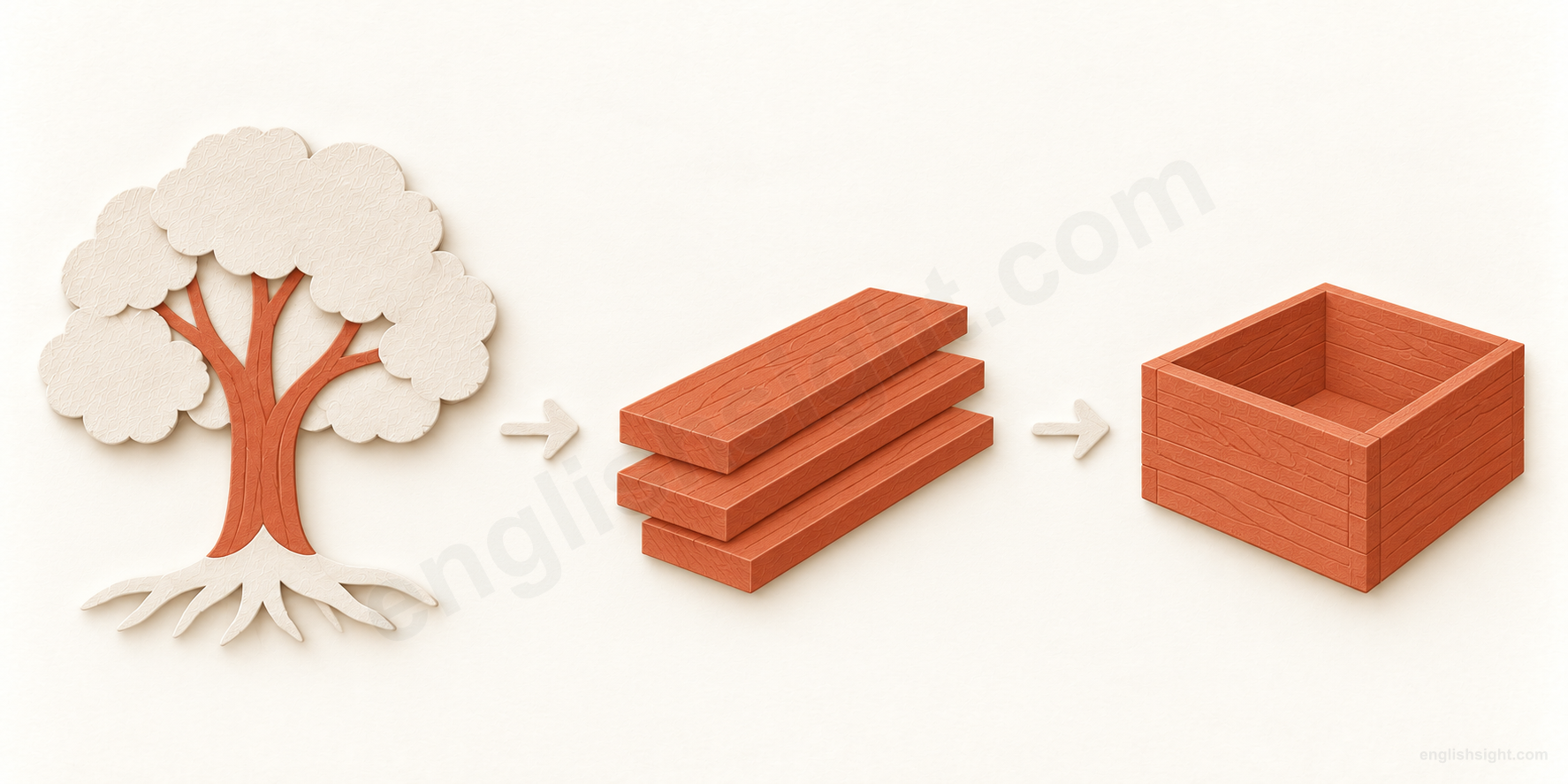
The material remains wood as its form changes
The material remains wood as its form changes
Wood in a tree
wood
Wood in a box
Cut into planks and shaped
Tree, planks, box: the form changes; the material remains wood.
Wood is the material in tree trunks and branches; cutting and shaping it can turn it into useful objects without changing the material name.
The diagram follows the material from a tree through a board to a box. The place meaning a wood / the woods is related to trees but is a separate noun use. Fixed expressions require their own explanations.
Wood names the material found in tree trunks and branches, whether it is still growing or has been cut and shaped for use. The same noun also names a tree-covered area: a wood or the woods.
Begin with the material, then notice the grammar and the whole expression. Some wood, two pieces of wood, different woods, and a walk in the woods answer different questions. The visual connection is a teaching model, not a claim about an identical mental picture for every English speaker.
01
Material, quantities, and useful objects
Start with the substance. Counting units, material types, and object descriptions change how the noun is used.
01
wood / some wood; the wood + singular verb
some wood
the material in tree trunks and branches
Situation / starting point
You inspect the material for a new shelf.
Meaning in context
You describe its quality and condition.
Wood names a substance, rather than a number of separate objects.
Wood can be part of a living tree, a cut board, or a finished object. A change of shape does not by itself change the material name. In ordinary material statements, wood is uncountable: some wood, a little wood, or enough wood.
The wood is dry describes a particular supply. Wood can rot makes a general statement without the. Useful descriptions include wet wood, dry wood, and rotten wood. The grain of the wood is the pattern or direction of its fibres, important when cutting or shaping it.
In a sentence
The wood is too wet to use for the shelf.
Watch the difference Use Wood is or The wood is for the material. Do not add -s just because you have a large quantity.
02
a piece / block / plank of wood; number + pieces of wood
a piece of wood
count a separate amount or shape of the material
Situation / starting point
A craft project needs two small parts.
Meaning in context
You ask for two separate pieces.
The countable noun piece, block, or plank supplies the unit.
Say a piece of wood or two pieces of wood when you count separate bits of the material. Piece is the head noun: one piece is, two pieces are. Wood stays singular after of.
A block of wood suggests a solid chunk; a plank of wood suggests a long, flat piece. These nouns give information that wood alone does not. A pile of wood describes an arrangement or supply, without specifying how many pieces it contains.
In a sentence
Could you cut two pieces of wood for the model?
Watch the difference For two separate bits, use two pieces of wood, not two woods. Woods can instead name tree-covered places or types of material.
03
tree name + wood; a kind of wood; different woods
different woods
different kinds of the material
Situation / starting point
A maker compares oak and pine.
Meaning in context
The discussion concerns types rather than individual boards.
The material name can be countable when it means a kind of wood.
Oak wood and pine wood identify the tree source. When comparing kinds, you can say different woods or several kinds of wood. A dark wood can also describe a kind of material; it can mean a tree-covered place in another context.
Hardwood and softwood are established material names you may see on products: oak is a familiar hardwood, and pine a softwood. Learn these as wood categories rather than using the spelling alone to predict every property of a board. The everyday adjectives hard and soft can also simply describe how a particular piece feels or behaves.
In a sentence
The workshop uses several different woods, including oak and pine.
Watch the difference Different woods here counts varieties, not individual pieces or necessarily separate wooded areas.
04
be made of / out of wood; wooden + object noun; wood + noun
made of wood / a wooden box
describe what an object is made from
Situation / starting point
You want to identify the material of a box.
Meaning in context
You describe a wooden object.
Wood is the material noun; wooden is an adjective that commonly comes before an object noun.
The box is made of wood identifies its material. A wooden box gives that description before box. Made out of wood is also natural when discussing making an object from that material.
Wood can itself modify another noun, as in wood floors, wood chips, or a wood fire. The relation depends on the whole combination: chips are pieces, while a fire burns the material. Do not assume that every wood + noun combination means made of wood.
It is wood can identify a material, especially when contrasting it with metal or plastic. To describe what a whole object is made from, It is made of wood is an explicit, useful choice. Wooden also has a separate figurative use, as in wooden acting, for a performance that lacks natural expression; an actor is not literally made of wood.
In a sentence
This wooden box is made out of leftover pieces of wood.
Watch the difference Wooden is an adjective: a wooden box, not a wooden. Do not say made of wooden without a following noun.
05
collect / chop / burn wood; wood for + fire / stove; a wood fire
chop wood for the fire
prepare or use wood as fuel
Situation / starting point
A household needs fuel for its stove.
Meaning in context
Pieces of wood are prepared for burning.
Chop and burn name the actions; wood names what is cut or used as fuel.
Collect wood, chop wood, and burn wood are ordinary verb-and-noun combinations, not phrasal verbs. Chop means cut into pieces, often with an axe; the fire or stove context explains why the wood is wanted.
Firewood names wood intended for burning. A wood fire is a fire fuelled by wood, and a wood-burning stove burns that fuel. A fire in the woods locates a fire in a tree-covered area; it is a different construction.
Dry wood contrasts with wet wood. Green wood in a fire-making or woodworking context means freshly cut wood that still contains moisture, not necessarily wood with a green colour. Seasoned wood has been dried for use.
In a sentence
We chopped some dry wood for the stove before sunset.
Watch the difference A wood fire describes the fuel. A fire in the woods describes the location. Neither phrase says the other by itself.
02
Living growth and tree-covered places
Wood can remain in a living plant. A wood or the woods can instead name the place where trees grow together.
06
old / young / new / dead wood; prune / remove + wood
old wood / dead wood on a tree
the woody growth of a tree or shrub
Situation / starting point
A gardener examines an old shrub.
Meaning in context
The gardener identifies growth to prune.
Wood need not have been cut down or turned into a product.
In gardening, wood can refer to a plant’s woody stems or branches. Old wood concerns older growth; young or new wood concerns more recent growth. Dead wood can literally be dead branches or other dead woody parts.
The adjective describes that growth: old does not automatically mean dead. Remove the dead wood tells someone what material to take away; remove and the context supply the action. The figurative expression dead wood in an organization is a separate established use, discussed below.
In a sentence
The gardener removed the dead wood from the apple tree.
Watch the difference A living tree contains wood too. Do not treat wood as a word that can only mean cut timber or furniture.
07
a wood; the woods; in / into / through the woods; at the edge of the woods
a wood / the woods
an area where trees grow together
Situation / starting point
You plan a walk near a tree-covered area.
Meaning in context
You describe a place rather than a material.
A wood is countable; woods is also an established form for a wooded place.
A wood is an area of trees, often smaller than a forest. The woods can refer to one tree-covered area or to several. It does not necessarily mean many separate forests. A wood is especially familiar in British English; woods is the usual form for this place meaning in American English.
In the woods gives a location; into the woods describes entering; through the woods describes a route within the area. At the edge of the woods and deep in the woods locate something relative to its boundary. The preposition contributes that relation, while woods names the place.
Compare We need some wood, meaning material, and We walked through a wood, meaning a place. Tree names can classify the place too: an oak wood contains oak trees. Several woods can mean several areas, whereas different woods in a furniture discussion usually means material types.
In a sentence
We followed a path through the woods behind the village.
Watch the difference Use in the woods for the familiar place expression. In wood normally describes a material or medium, as in a carving in wood.
03
Established expressions in conversation
These expressions draw on luck, places, whole-versus-parts thinking, or pruning. Learn their full forms and meanings rather than predicting them from the material alone.
08
positive statement + touch wood / knock on wood
touch wood / knock on wood
express a hope that good luck will continue
Situation / starting point
You mention that something has gone well so far.
Meaning in context
You add a conventional hope that it will stay that way.
The whole saying has a social meaning beyond touching a material.
Touch wood is especially British; knock on wood is the corresponding American saying. Speakers use it when mentioning good fortune or a hoped-for outcome, as if to avoid tempting bad luck.
The expression may accompany a touch or a knock on a wooden surface, but in conversation the words themselves communicate the wish. It is a familiar convention, not a claim that touching wood can guarantee an outcome. Ordinary Touch the wood could instead be a literal instruction to feel a material.
In a sentence
The old car has started every morning this winter, touch wood.
Watch the difference Keep the forms distinct: touch wood; knock on wood. Adding the gives a different literal instruction unless the context establishes otherwise.
09
be out of the woods; not be out of the woods yet
not out of the woods yet
still facing difficulties or possible trouble
Situation / starting point
A difficult situation begins to improve.
Meaning in context
You point out that problems still remain.
Leaving a difficult place is a useful memory image; the idiom need not concern trees.
In informal English, be out of the woods means be past the difficulties; the familiar negative not out of the woods yet warns that improvement is not the same as being clear of trouble. It can refer to a person, a project, or a wider situation.
Yet emphasizes that the hoped-for safe stage has not been reached. In The project is not out of the woods yet, no physical journey is taking place. Learn the whole expression; out of plus another material noun will not automatically have this meaning.
In a sentence
The repairs are going well, but we are not out of the woods yet.
Watch the difference Not out of the woods does not mean that nothing has improved. It means the problems are not fully behind you.
10
in / from + my / your / this neck of the woods
your neck of the woods
your local area or part of the country
Situation / starting point
You discuss visiting the area where a friend lives.
Meaning in context
You refer to that area in a friendly, informal way.
Neck of the woods names a locality, without requiring any trees.
Your neck of the woods means the area you live in or come from. My neck of the woods refers to mine; this neck of the woods refers to the present or relevant locality.
Use in for location and from for origin: in your neck of the woods, from my neck of the woods. These prepositions work with the full place expression. Neck does not refer to a person’s body here, and woods does not promise that the area is rural.
In a sentence
Are buses frequent in your neck of the woods?
Watch the difference Keep the fixed phrase neck of the woods. It is informal wording for an area, not a precise address or an anatomical description.
11
cannot / can’t see the wood for the trees; can’t see the forest for the trees
can’t see the wood for the trees
miss the main point because the details occupy your attention
Situation / starting point
Someone examines small details of a plan.
Meaning in context
The overall aim receives too little attention.
The wood is the whole area; the trees are its individual parts.
The British expression can’t see the wood for the trees describes losing sight of the overall issue by concentrating on details. American English usually has can’t see the forest for the trees. Both make the same whole-versus-parts comparison.
For the trees identifies what prevents a clear view in this fixed expression. It is not a purpose phrase meaning for the benefit of the trees. In a planning discussion, see means understand, not physically look at a landscape.
In a sentence
We are arguing about the font and can’t see the wood for the trees: the instructions are still unclear.
Watch the difference The wood is singular in this British idiom. Changing it to woods loses the usual fixed form.
12
dead wood; clear out / cut out / remove + the dead wood
clear out the dead wood
remove people or things judged no longer useful
Situation / starting point
An organization reviews old procedures.
Meaning in context
It removes procedures it regards as ineffective.
This is an evaluative metaphor, not a neutral description of age.
Dead wood can describe people or things considered to contribute nothing useful in an organization or situation. Clear out, cut out, or remove supplies the action; dead wood names what is being criticized.
The memory link is to pruning dead woody growth, but usefulness in an organization is a judgment. Calling colleagues dead wood is dismissive and can be insulting. For neutral wording, identify the actual problem, such as outdated procedures or roles that are no longer needed.
In a sentence
The team wants to clear out the dead wood in its reporting system.
Watch the difference Old does not automatically mean useless. Literal dead wood on a tree and this critical expression belong to different contexts.
Read the noun and the whole phrase
Material, kinds, and places have different counting patterns
For the substance use wood with singular agreement. Count separate objects with pieces of wood, varieties with kinds of wood or woods, and wooded places with a wood or woods. Context matters: an oak wood can be a place, while oak wood in a furniture description names material.
Wood and would sound alike
Wood is pronounced /wʊd/, the same as the usual full pronunciation of would. Spelling and sentence structure separate them: We need wood names material; We would help uses a modal verb. There is no connection between their grammar.
A noun lesson, with a few related words
These modern everyday uses are nouns, including wood used before another noun. Wooden is a related adjective. The rare verb wood, meaning to supply fuel or plant trees, is not needed for these patterns. Wood has no everyday particle-verb family to learn here.
Specialist meanings remain outside the main units
In golf, a wood is a type of club with a large head; its head need not be wooden today. Bowls, racket sports, musical shorthand, barrel terminology, regional expressions, archaic meanings, and vulgar slang are not developed in this introductory course. The selection is not an exhaustive dictionary.
Choose the meaning that fits
Use the situation, countability, and fixed expression to choose.
1. You need two separate bits of material for a model. What should you ask for?
2. You followed a trail among trees behind the village. Which sentence describes the place naturally?
3. A furniture maker compares different woods, including oak and pine. What is being compared?
4. You say that your bicycle has never broken down and hope this continues. Which familiar addition fits?
5. A repair is improving but serious problems remain. What does We’re not out of the woods yet communicate?
6. A team argues over tiny design choices and overlooks the main purpose. Which expression fits?
Sources and teaching notes
The sources below support the meanings, constructions, and regional notes. Explanations and examples are original. The tree-to-object visual connection is a teaching interpretation.
This diagram helps explain a connection; it is not a picture shared by every native speaker.