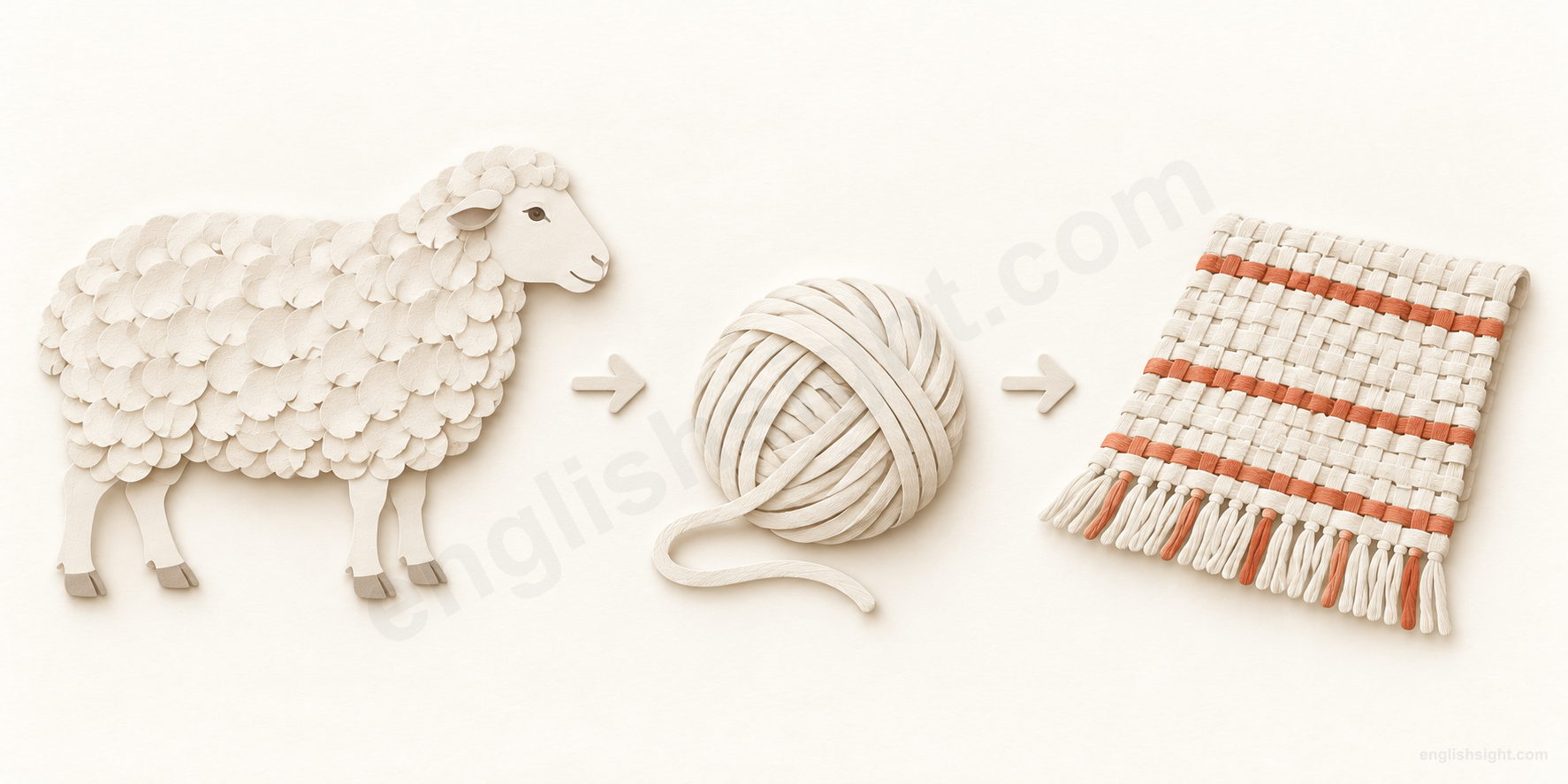
Follow wool from an animal’s coat to yarn, fabric, and familiar expressions.
One material, changing form
The material remains wool as its form changes
Wool forms the sheep’s curly coat.
wool
The woven cloth is another form of the same material.
Wool fibres are spun into yarn and woven into cloth.
From a sheep’s coat to yarn and cloth, the material can still be called wool.
Wool names animal fibre, especially sheep’s, and the yarn or fabric made from it.
The arrows connect stages of making a material into useful things. They are not a verb meaning hidden inside wool. Similar-looking fibres and fixed idioms form separate branches.
Wool /wʊl/ is mainly a material noun. It can name the fibre on a sheep, the yarn used for knitting, or cloth made from that fibre. The surrounding words tell you which form matters.
The material connection is a useful teaching picture. Compounds and idioms need their own explanations; this picture does not predict every expression containing wool.
01
From an animal’s coat to yarn and cloth
The form changes, but wool can still name the material. Context tells you which stage is meant.
01
sheep’s wool; wool from + animal
sheep’s wool
the soft, usually curly hair of sheep and certain other animals
Situation / starting point
A sheep has a thick coat.
What is meant
The fibre is named as a material, on or off the animal.
Wool names the fibre; it is not a general word for every animal’s hair.
Start with the material on the animal. Sheep’s wool identifies its source; raw wool refers to wool before processing. Removing it does not stop it being wool.
Fleece can mean a sheep’s entire wool coat, including the coat after shearing. Wool focuses on the material; a fleece can identify one whole coat. In a clothing shop, fleece can also name a soft fabric or a jacket, so that word alone does not guarantee animal wool.
In a sentence
The farmer sells wool from her sheep to a local mill.
Watch the difference For a dog’s ordinary coat, say hair or fur; do not automatically call it wool.
02
knitting wool; spin wool; knit with wool; wool yarn
knitting wool
wool spun into a long strand for knitting or weaving
Situation / starting point
Loose wool fibres are prepared.
What is meant
A strand can be used to make cloth or clothing.
Wool can name the yarn, not just loose hair.
In a knitting context, wool can mean the strand you work with. Spin wool describes making yarn from fibres; knit with wool describes using yarn to make a knitted item. The verbs tell you the process.
Yarn is the broader word for spun thread used in knitting or making cloth. Cotton yarn is yarn but is not animal wool. Wool yarn specifies both the form and the material; yarn is the clearer choice when you do not know the fibre content.
In a sentence
I bought blue knitting wool to make a hat.
Watch the difference A ball describes how yarn is wound, not which fibre it contains.
03
be made of wool; be wool; a length of wool
made of wool
made from wool material
Situation / starting point
You examine a scarf and want to identify its material.
What is meant
You describe the scarf as a wool product.
The same material name extends to cloth and finished objects.
A scarf made of wool is a scarf whose material is wool. Wool can also name the cloth itself: a length of wool for a coat. The context distinguishes cloth from knitting yarn.
The scarf is wool is a natural short material description. This is not an action: made of tells you its composition. The diagram links fibre, yarn, and woven cloth; it does not show a single verb meaning change into.
In a sentence
This scarf is made of wool, but the lining is cotton.
Watch the difference Wool is a material, so wool alone does not identify the garment: buy a wool scarf, not a wool meaning one scarf.
02
Describe, measure, and buy wool
Use material expressions and quantity words to say what something contains and how much you need.
04
wool + noun; woollen / woolen + noun
a wool coat
a coat described by its material
Situation / starting point
Two coats have different materials.
What is meant
Wool identifies the relevant kind of coat.
A material noun can come before the name of an object.
In a wool coat, coat is the thing and wool specifies its material. The same pattern gives wool socks and a wool blanket. Wool is used as a modifier; it is not a verb or a plural garment name.
Woollen is an adjective meaning made of wool; North American spelling is woolen. A woollen blanket and a wool blanket can describe the same material. Woollen can also describe the industry that makes wool cloth, as in a woollen mill.
In a sentence
I left my wool coat beside the door.
Watch the difference Keep the material modifier singular: wool socks, not wools socks.
05
pure / 100% wool; a wool blend; new / virgin wool
pure wool / a wool blend
describe fibre content and whether wool has been used before
Situation / starting point
You compare labels on two blankets.
What is meant
You distinguish all-wool material from a mixture.
Pure describes composition; new describes first use of the fibre.
Pure wool and 100% wool describe material consisting of wool rather than a mixture with another fibre. A wool blend combines wool with another fibre; a label such as 70% wool identifies the wool proportion.
New wool means wool being processed or woven for the first time; virgin wool is the usual American term. New does not simply mean that the garment was bought recently. Pure new wool combines two claims: wool content and first use.
In a sentence
This blanket is pure wool; that one is a wool blend.
Watch the difference A wool blend is not the same claim as 100% wool; new wool does not mean newly purchased clothing.
06
some / much wool; number + balls of wool; weight + of wool
two balls of wool
count units while treating wool as a material
Situation / starting point
You need enough yarn for a project.
What is meant
You specify the quantity using balls or a weight.
Count the unit, not the everyday material noun.
For ordinary quantities, wool is uncountable: some wool, more wool, or How much wool? Use a unit when counting: a ball of wool, two balls of wool, or 100 grams of wool. With two balls, balls takes the plural ending.
You may meet wools in textile discussion when different types of wool are compared. That special use does not make two wools the normal way to ask for two balls of knitting yarn.
In a sentence
Will two balls of wool be enough for this hat?
Watch the difference Say I need some wool or a ball of wool, not I need a wool for an unspecified quantity.
03
Other materials with wool in the name
These compounds name masses of fibres that resemble wool. The first word tells you what they are made of.
07
some cotton wool; a cotton wool pad; cotton wool balls
cotton wool
a fluffy mass of cotton, especially for use on the skin
Situation / starting point
You need a soft pad for applying lotion.
What is meant
You choose a cotton product rather than sheep’s wool.
Cotton identifies the material; wool suggests its fluffy form.
Cotton wool is a fixed compound for soft cotton, often supplied as balls or pads. It does not mean cotton mixed with animal wool. The fibres resemble a loose mass of wool.
This name is especially British. American English generally uses cotton or absorbent cotton for the material. A cotton ball and a cotton pad name individual shaped pieces.
In a sentence
She put a little lotion on a cotton wool pad.
Watch the difference Read the whole compound: cotton wool is a cotton product, not ordinary knitting wool.
08
some steel wool; a steel wool pad; wire wool
steel wool / wire wool
a mass of fine steel strands for cleaning or smoothing surfaces
Situation / starting point
A surface needs scrubbing or smoothing.
What is meant
A pad of fine metal fibres is selected.
The resemblance concerns thin tangled strands, not animal origin.
Steel wool consists of very fine steel strands gathered together. The word steel names the substance; wool describes its fibre-like arrangement. It is used for tasks such as cleaning pans or smoothing surfaces.
Wire wool is another British name for this material. Some steel wool names an amount; a steel wool pad names one shaped item. Wool in this compound does not promise softness against skin.
In a sentence
There is a steel wool pad beside the workshop sink.
Watch the difference Steel wool is metal, not wool yarn with a metallic colour.
04
Deception, firm beliefs, and too much protection
Learn these whole expressions. Their meanings cannot be worked out simply by substituting the word fibre.
09
pull the wool over + person’s + eyes
pull the wool over someone’s eyes
deceive someone about your real actions or intentions
Situation / starting point
A customer needs accurate information.
What is meant
A seller tries to make the customer believe something false.
The eyes belong to the person being deceived.
This informal idiom means deceiving someone, often to hide what is really happening. The image of blocking someone’s sight can help you remember it, but no actual wool or physical eye covering is needed.
Keep the full pattern: pull the wool over my eyes, her eyes, or the customers’ eyes. The possessive identifies the person being misled. The subject does the deceiving; the possessor of eyes is the target.
In a sentence
The seller tried to pull the wool over my eyes about the car’s history.
Watch the difference This is a fixed idiom, not a freely replaceable material expression; cotton or steel cannot replace wool.
10
a dyed-in-the-wool + noun for a person or outlook
a dyed-in-the-wool traditionalist
a person with strongly fixed beliefs or attitudes
Situation / starting point
New methods are suggested.
What is meant
A person remains firmly committed to the old approach.
The whole adjective describes a deeply established outlook.
A dyed-in-the-wool traditionalist is firmly attached to traditional ideas and unlikely to change. The expression usually comes before a noun and often sounds disapproving, especially when it suggests stubbornness.
The colour-in-the-fibre association is a memory aid for something deeply established. In this figurative expression, dyed-in-the-wool describes the person or their beliefs, not the colour or material of their clothes. Use dyed, the past participle of dye, not died.
In a sentence
As a dyed-in-the-wool traditionalist, Eva resisted the new teaching method.
Watch the difference Do not use this phrase merely for someone wearing dyed wool; the figurative sense concerns a firmly fixed character or belief.
11
wrap + person + (up) in cotton wool; be wrapped in cotton wool
wrap someone (up) in cotton wool
protect someone so carefully that it becomes excessive
Situation / starting point
A child wants to try an ordinary activity independently.
What is meant
An adult tries to prevent every possible difficulty.
Cotton padding is a metaphor for excessive protection.
This British idiom criticizes being too protective. It does not describe a useful amount of care or say that all protection is wrong. In a discussion about independence, the complaint is that someone is being shielded too much.
Up is optional: wrap someone in cotton wool and wrap someone up in cotton wool carry this meaning. You can also describe someone as being wrapped in cotton wool. Learn the complete expression rather than treating wool as a verb meaning protect.
In a sentence
“Let him try it himself; you can’t wrap him in cotton wool,” said his aunt.
Watch the difference The idiom needs cotton wool; wrap someone in wool on its own may simply mean covering them with a woollen material.
Choose the material and the whole expression
A noun, not an action
In this lesson wool is a noun, including its use before another noun. Spin, knit, weave, and make name the actions. Verb tense, causative, passive, and phrasal-verb families are not productive wool patterns; passives inside the examples belong to other verbs.
Warm or fluffy does not automatically mean wool
Yarn names a form, wool names a material, and a clothing item called a fleece need not be animal wool. Read the fibre description when composition matters. Cotton wool and steel wool name different substances.
Everyday scope
This selection covers material uses, shopping and craft language, two wool idioms, and the British cotton-wool idiom. Botanical hair coverings, specialist insulation terminology, historical expressions, and related words such as woolly or wool-gathering are not developed here.
Read the material, unit, or idiom
Choose the expression that fits the intended meaning.
1. You want enough knitting yarn from the shop, measured as two wound units. Which request is natural?
2. A scarf contains wool mixed with another fibre. Which description fits?
3. Which material consists of fine metal strands?
4. A seller hides a repair and tries to make you believe a used car has never been damaged. Which phrase describes the attempt?
5. An aunt thinks a child is being protected from every small difficulty. What might she say?
Sources and teaching notes
The main uses were checked against publisher dictionary pages. The cotton-wool protection idiom was checked in a Cambridge publisher search excerpt and against the related Collins meaning; its full Cambridge page was blocked. Explanations and examples are original teaching material.
The diagram is a teaching connection, not a picture shared by every native speaker.