Move from individual words to what people say, report, promise, and mean.
One unit within an expression
One unit within an expression
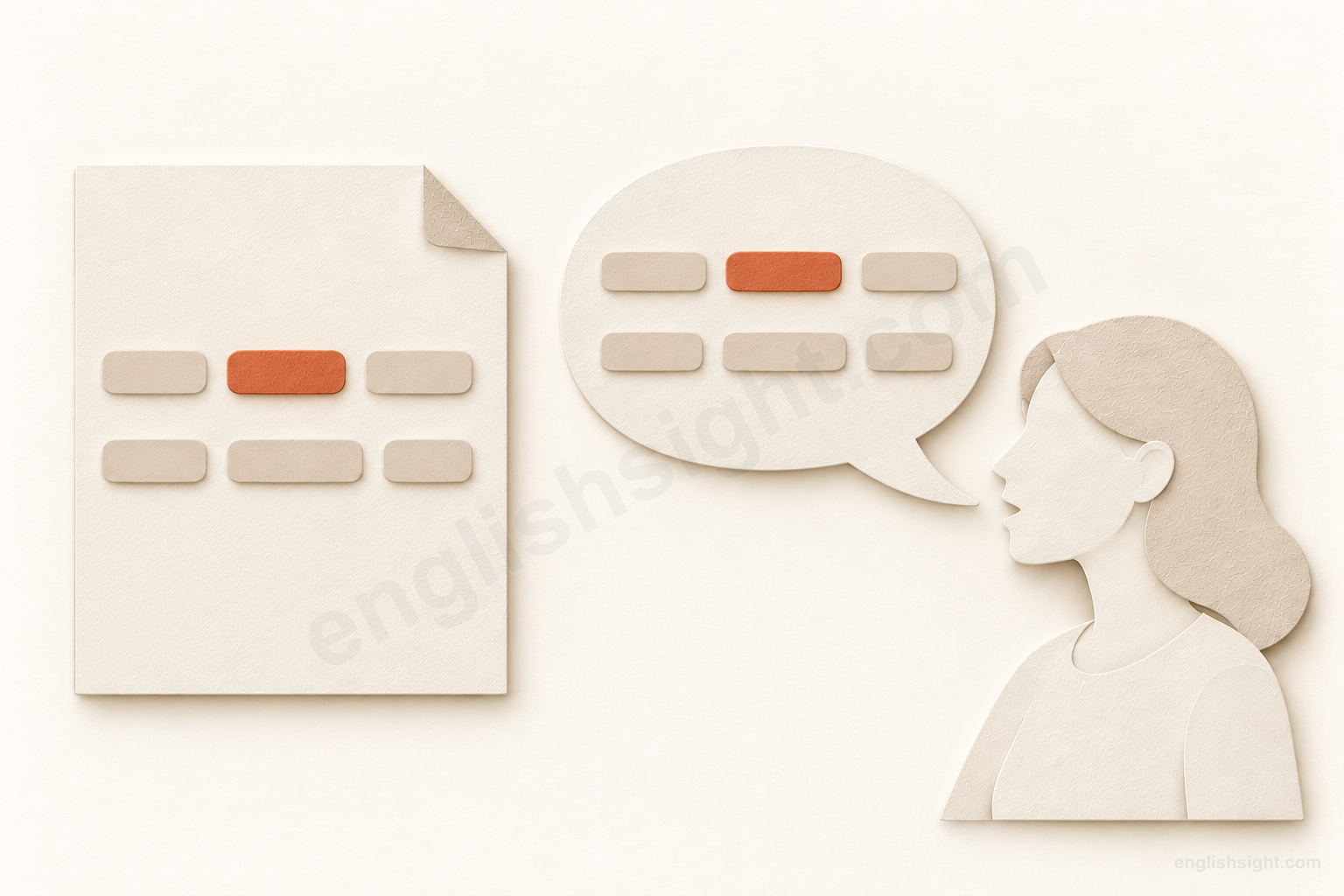
A written expression appears on a page.
word
A speaker produces a spoken expression.
One language unit is highlighted in each expression.
A word is a language unit in writing or speech.
A word is one recognizable unit of spoken or written language, used to express meaning as part of an expression.
This is a teaching model for the ordinary language sense. The highlighted marks stand for a word in writing and in speech, not for actual letters or measured sound boundaries. Promise, news, and idiomatic uses are explained in their own contexts; the model does not predict them mechanically. It is not a claim about every speaker’s mental imagery.
A word is a recognizable unit of language that can be spoken or written. Words form expressions; in established patterns, word can also stand for a remark, news, an assurance, or a signal to act.
Begin with the language unit, then read the whole construction. Have a word, have words, give my word, and give the word do different jobs. The shared spelling does not make them interchangeable.
01
Language units and what people say
Begin with a single word, then distinguish the words themselves from the message, song, or act of choosing them.
01
a / one / several + word(s); the + language + word for + thing / idea
a word / the word for something
one unit of language, or the expression used for a concept
Situation
You need the English name for a small animal.
What the expression does
You ask which word expresses that meaning.
A word is a language unit; its letters, sounds, and meaning are different aspects.
A word can be spoken or written. Count the units when giving a word limit: a short report might contain eighty words. A letter is one written character; a phrase can contain several words. A term can be a specialized word or phrase, such as a name used in medicine.
Ask What is the English word for this animal? For connects the expression to what it names or expresses. A word can have several meanings, and some words, such as if, express a grammatical relationship rather than name an object.
In the true sense of the word emphasizes a particular meaning: She is an artist in the true sense of the word. The operative word is the crucial expression in a statement: We might finish today—might is the operative word. Neither phrase describes a special kind of spelling.
In a sentence
What is the English word for this animal?
Watch the difference Use for to connect a word with a meaning: the word for it, not the word of it.
02
somebody’s words; words of + encouragement / comfort; the words to / of + song
her words / the words to a song
the language someone uses, including lyrics
Situation
You recognize a tune but cannot sing along.
What the expression does
You ask for the language sung with it.
Words can mean the verbal content, rather than separately counted vocabulary items.
Her words means what she said or wrote. In Thank you for your kind words, the focus is her supportive message. Words of encouragement, comfort, or praise describe its function. Someone of few words usually says little; that does not imply a small vocabulary.
The words to a song, or the words of a song, are its lyrics, as distinct from its tune or instrumental music. The written word means language in writing generally; the printed word focuses on published writing. These are broader expressions, not one particular word.
Hang on someone’s every word means listen with absorbed attention: The children hung on her every word during the story. The attention belongs to this whole idiom, not to the literal action of hanging.
In a sentence
I know the tune, but I have forgotten the words to the song.
Watch the difference Keep words plural when you mean the lyrics as a whole.
03
word + message + adverb; message + be worded + adverb
word a request carefully
choose the language used to express a message
Situation
Your first draft sounds too demanding.
What the expression does
You choose a more considerate form of request.
The verb word acts on a message, question, letter, or similar expression.
To word something is to decide how to say or write it. Word the request carefully changes its phrasing; it does not necessarily change the request itself. Differently and more clearly can also describe how it is worded.
The passive is natural: The notice was worded politely. The forms are word, words, worded, wording. I am wording the invitation describes an activity in progress. Wording also names the chosen language: Please check the wording of the invitation.
Choose your words carefully and weigh your words emphasize care before speaking. They are useful near-equivalents in this setting, but choose has words as its object, whereas word has the message as its object.
In a sentence
We worded the request politely so that it sounded like an invitation.
Watch the difference Say word the question carefully or choose your words carefully; do not confuse their objects.
04
a play on words; make a play on words
a play on words
humor that uses two meanings or similar language forms
Situation
A bakery advertises its knead for more staff.
What the expression does
You notice that knead sounds like need.
The joke depends on language, not simply on an amusing situation.
A play on words is a pun. In our invented bakery example, knead describes working dough while sounding like need. The reader recognizes the alternative reading; the humor comes from the connection between forms and meanings.
A single word can also have two relevant senses. Knowing both senses helps explain the joke, but translating each word literally may remove it. The expression play on words is learned as a noun phrase.
In a sentence
The bakery’s sign about its knead for staff is a play on words.
Watch the difference An ordinary joke is not necessarily a play on words; it must exploit language.
02
Exact wording, new wording, and expression
Choose whether to quote, paraphrase, explain, summarize, or admit that language cannot capture what you feel.
05
explain / describe / retell + something + in + possessive + own words
in your own words
express an account using your own phrasing
Situation
You have read a paragraph in a textbook.
What the expression does
You explain its message without copying its sentences.
Preserve the relevant meaning while choosing the language yourself.
A teacher asking for an explanation in your own words usually wants evidence of understanding. You can keep necessary names or technical terms; the instruction does not mean replace every individual word.
Compare In Lena’s words, the trip was “a wet adventure.” That attributes the quoted wording to Lena. In her own words can also introduce someone’s actual phrasing in reported material. Read whose account is being given and whether the task is paraphrasing or quoting.
In a sentence
Explain the main idea in your own words, without looking at the paragraph.
Watch the difference In your own words does not license changing the facts or adding claims.
06
repeat / copy / translate + something + word for word; a word-for-word + noun
word for word
reproduce the original wording exactly
Situation
You still have the original message.
What the expression does
You repeat its exact wording.
The expression specifies correspondence between the original and the repetition.
Repeat or copy something word for word means preserve the original language rather than paraphrase it. In a report, it distinguishes an exact quotation from a summary.
Translate word for word means match individual words closely rather than translate by the overall sense. That can produce unnatural language. A word-for-word copy uses hyphens before the noun; word for word after repeat is normally unhyphenated.
In a sentence
I copied the message word for word, including the unusual greeting.
Watch the difference Exact copying and a good translation are different goals; literal word matching does not ensure natural meaning.
07
statement; in other words, + reformulation
in other words
explain the same point with different wording
Situation
A rule says that the pass is valid for one entry only.
What the expression does
You explain that it cannot be used twice.
The second statement restates or interprets the first.
In other words introduces a reformulation, often a simpler one. It can make a practical implication explicit, as in the pass example, rather than merely substitute synonyms.
It does not normally introduce an unrelated additional point. Use for example when giving an instance, and also when adding information. In words of one syllable is an idiom for very simple language; it is not always a literal requirement that every word have one syllable.
In a sentence
The pass allows one entry only. In other words, you cannot use it twice.
Watch the difference In another word is not the usual expression for reformulating a whole statement.
08
in a word, + brief answer / assessment
in a word
give a very brief overall answer or assessment
Situation
Someone asks for your overall impression of the concert.
What the expression does
You sum it up as wonderful.
A compact assessment replaces a longer explanation.
In a word announces a compressed answer or summary. It is useful for a sharp conclusion and may sound deliberately emphatic: In a word, wonderful.
It differs from in other words, which reformulates an earlier statement. The expression is often followed by one word, but its conversational purpose is brevity, not a strict word-count rule.
In a sentence
“How was the concert?” “In a word, wonderful.”
Watch the difference Do not use in a word to introduce a long new explanation without an intended rhetorical effect.
09
(not) say + something + in so many words; (not) tell + person + in so many words + that + clause
not in so many words
a meaning was implied rather than directly stated
Situation
A colleague questions every detail of your plan.
What the expression does
You infer doubt, although the colleague did not explicitly reject it.
Separate someone’s actual wording from your interpretation.
Not in so many words acknowledges that the exact explicit statement was not made. It is a useful reply when someone asks Did she actually say that? Your inference might still be reasonable, but it is not a quotation.
The positive pattern in so many words means explicitly or plainly: He told us in so many words that the offer was final. Many does not measure the length of the speech in this idiom. In this reporting pattern, tell takes a listener as its object: tell us that something is true. Say can introduce the statement without naming a listener.
Words to that effect marks approximate reporting: He asked us to leave, or words to that effect. It gives the general message while allowing that the original wording was different.
In a sentence
“Did she say the plan would fail?” “Not in so many words, but she sounded doubtful.”
Watch the difference Do not present an inference as an exact quotation just because it seems clear to you.
10
put + idea / feeling + into words; find the words to + verb
put something into words
find language for an idea or feeling
Situation
You feel grateful but struggle to explain why.
What the expression does
You try to formulate what you feel.
Words provide a form for something you want to express.
Put a feeling, thought, or experience into words means express it in language. The thing expressed is the object of put; into words names the form of expression.
Find the words to thank someone focuses on managing to formulate the message. Words fail me says that you cannot adequately express your reaction, sometimes because of gratitude or shock, and sometimes because you are exasperated.
In a sentence
I find it hard to put my gratitude into words.
Watch the difference Use into words for expression, not in other words, which introduces a reformulation.
11
be lost for words; feeling + be beyond words; too + adjective + for words
lost for words / beyond words
unable to respond, or beyond adequate description
Situation
The unexpected gift leaves you overwhelmed.
What the expression does
You cannot immediately find anything to say.
Speechlessness and a reaction too strong to describe are related but distinct.
Be lost for words describes a person who cannot think of a response, often through surprise, emotion, or confusion. It does not normally mean forgetting foreign-language vocabulary.
Beyond words describes the strength of a feeling or quality: Her relief was beyond words. Too upsetting for words similarly intensifies an evaluation. You can be moved beyond words and still speak; the claim is that language feels inadequate.
In a sentence
When I opened their gift, I was lost for words.
Watch the difference Lost for words describes the person; beyond words can describe the feeling itself.
03
Taking part in a conversation
Small changes matter: have a word is a short conversation, while have words can mean an argument.
12
have a (quick / quiet) word with + person + about + topic
have a word with somebody
speak briefly with a person
Situation
You need to discuss a small issue with your colleague.
What the expression does
You ask for a short conversation.
A word can stand for an entire brief exchange.
Could I have a word with you? asks to speak, often privately or about something specific. Quick and quiet can describe the exchange. It may introduce a concern, but it does not automatically mean a quarrel.
Have a word in someone’s ear is a British expression for speaking privately. Say a few words about something instead often means make a short speech or contribution, perhaps at a welcome event. Neither expression specifies an exact number of words.
In a sentence
Could I have a quick word with you about tomorrow’s meeting?
Watch the difference Have a word with someone and have words with someone differ; the plural expression can imply an argument.
13
a word of + warning / advice / thanks; a word to the wise
a word of warning / advice
a short message that warns or advises
Situation
A visitor is about to take a difficult path.
What the expression does
You briefly warn them about the slippery steps.
A word of introduces the purpose of a remark.
A word of warning can introduce a caution before it becomes relevant. A word of advice similarly offers guidance. The remark can contain a whole sentence or more; word presents it as a brief contribution.
The article belongs to word: a word of advice, although advice itself is normally uncountable. A word of thanks offers brief gratitude. A word to the wise introduces advice the speaker expects the listener to recognize as useful.
In a sentence
A word of warning: the steps become slippery after rain.
Watch the difference Say a word of advice, not an advice. The expression can sound pointed if the advice is unwelcome.
14
not a word to + person + about + topic; without a word; not + verb + a word
not a word / without a word
nothing said, or an instruction to keep something secret
Situation
You want the surprise party to remain secret.
What the expression does
You tell a friend not to mention it.
Under negation, even one word stands for any speech about the matter.
Not a word to Sam about the party means do not tell Sam anything about it. Don’t breathe a word is another emphatic secrecy instruction. Mum’s the word is an informal assurance or request to keep quiet about a secret.
She left without a word describes leaving silently, without saying anything. I didn’t understand a word means I understood none of what was said. The same minimal unit strengthens a negative claim; the verb and context decide whether it concerns speaking, understanding, or believing.
In a sentence
Not a word to Sam about the surprise party!
Watch the difference No word from Sam is a news pattern; not a word to Sam is a secrecy instruction here.
15
have / exchange words with + person + about + topic
have words with somebody
have an angry or serious disagreement
Situation
A neighbor repeatedly blocks your gate.
What the expression does
You confront the neighbor about the behavior.
Without a, have words can suggest conflict rather than a neutral chat.
We had words with the neighbor about the gate implies a disagreement or sharp discussion. The idiom is especially associated with British usage. Exchange words can also describe an argument, but exchange a few words may simply mean talk briefly.
A war of words is a continuing verbal dispute, often between public figures or groups. A cross word is an angry remark. These expressions concern the social use of speech, not the number of vocabulary items used.
In a sentence
We had words with the neighbor after he blocked our gate again.
Watch the difference Do not use have words as a neutral substitute for have a word.
16
can / cannot get a word in (edgeways / edgewise)
get a word in edgeways / edgewise
manage to speak while someone else is talking a lot
Situation
One participant keeps talking through the meeting.
What the expression does
You struggle to contribute anything.
The difficulty is gaining a turn, not finding vocabulary.
I couldn’t get a word in complains that another speaker left no opportunity to speak. Edgeways is usual in British English; edgewise is usual in North American English and is also found in British English.
Get a word in can be used without the final adverb. In this idiom, in suggests contributing to the ongoing conversation. It is a get construction containing the noun word, not a phrasal verb headed by word.
In a sentence
Nina talked so much that I couldn’t get a word in edgeways.
Watch the difference Use get a word in for lack of a speaking opportunity; lost for words means inability to think of a response.
17
put in a good word for + person + with + decision-maker
put in a good word for somebody
recommend or speak favorably about a person to help them
Situation
A friend is applying to a team you know.
What the expression does
You offer to mention their strengths to the manager.
A favorable comment can support another person’s prospects.
Put in a good word for someone means speak positively about them to somebody whose judgment may matter. For names the person you support; with can name the person you approach.
Not have a good word to say about someone means never speak favorably about them. Not have a bad word to say about someone points the other way: you have no criticism to offer. These negative patterns are not interchangeable.
In a sentence
Could you put in a good word for me with the hiring manager?
Watch the difference A good word may help, but it is not a promise that the application will succeed.
04
Messages and information spreading
In these patterns, word is news or information rather than an item counted on a page. Learn the articles and prepositions with the expression.
18
send / get word that + clause; word from + person; word of + event
send word / no word from somebody
send or receive a message or news
Situation
You are waiting to hear whether your friend arrived.
What the expression does
No message has arrived yet.
Here word refers to news, not a countable vocabulary item.
Send word that… reports communicating a message: She sent word that she was safe. Get word of an event means learn about it. Word from someone identifies the source; word of an event identifies what the news concerns.
There is still no word from Jo means no news or message has come from Jo. Dictionaries may label this sense singular or uncountable; in these everyday patterns it normally has no indefinite article or plural ending.
In a sentence
There is still no word from Jo about the journey.
Watch the difference No word is not proof that something bad happened; it reports absence of news.
19
spread / pass the word about + topic; word gets out about + topic
spread the word / word gets out
tell others, or have information become known
Situation
A community group opens a free repair service.
What the expression does
Members tell more people about it.
Intentional publicity and information escaping are different situations.
Spread the word about a service means help more people hear about it. Pass the word similarly asks people to relay a message. The is part of these familiar expressions; do not copy that article into every news pattern.
Word gets out means information becomes more widely known, sometimes despite attempts at secrecy: Word got out about the planned closure. The people responsible need not be named. Word spreads focuses on circulation without necessarily suggesting a secret.
In a sentence
Please spread the word about our free repair service.
Watch the difference Spread the word is usually intentional; word got out does not necessarily say who disclosed it.
20
hear / spread / learn + by word of mouth; word-of-mouth + noun
by word of mouth
through people telling one another
Situation
A neighbor recommends a small café.
What the expression does
You visit because of that recommendation.
The expression identifies a way information travels.
Hear about something by word of mouth means learn through people telling each other. Businesses may gain customers this way through personal recommendations rather than formal advertising.
Word-of-mouth recommendation can be used before a noun with hyphens. The expression describes communication between people; it does not mean that the information must be true or officially checked.
In a sentence
We heard about the café by word of mouth.
Watch the difference Keep the fixed form word of mouth, not words of mouths.
21
word has it that + clause; the word (on the street) is that + clause
word has it that…
report what people are saying
Situation
Several coworkers mention a possible new office.
What the expression does
You pass on the report without claiming confirmation.
The source is circulating talk rather than direct proof.
Word has it that… introduces a report or rumor. The word is that… and the word on the street is that… also present what is being said. The idiom can be used for ordinary news as well as gossip.
Has it belongs to the established pattern; it does not refer to a physical thing possessed by word. These expressions identify a report, not a reliable method of verifying it. If the source matters, say who actually told you.
In a sentence
Word has it that the company is opening a new office.
Watch the difference Do not treat circulating talk as confirmed just because the sentence uses has it.
05
Promises, trust, and permission to act
A statement can function as a commitment, an assurance, an account of events, or a signal to begin. The full construction tells you which.
22
give + person + possessive + word + (that) + clause; you have my word
give somebody your word
make a firm promise or assurance
Situation
A friend needs their bicycle back by Friday.
What the expression does
You commit yourself to returning it on time.
Your word stands for a commitment the other person is asked to trust.
Give someone your word that… makes a serious promise. The possessive identifies the person making it: I give you my word, not I give you your word. Word of honor adds a solemn tone.
You have my word is another assurance. Compared with a casual prediction, these expressions stress personal responsibility for what you say. Their force comes from the promise sense and the full social situation, not from one isolated language unit.
In a sentence
I give you my word that I will return your bicycle by Friday.
Watch the difference Give the word means give a signal or instruction; give my word means make my promise.
23
keep / break / go back on + possessive + word; be true to + possessive + word
keep / break your word
fulfill or fail to fulfill a promise
Situation
Someone promised to help with the move.
What the expression does
They arrive and do what they promised.
What happens afterward is measured against the earlier commitment.
Keep your word means do what you promised. Break your word or go back on your word means fail to honor that promise. These patterns keep word singular, even when the promise took many words to express.
True to her word and as good as her word describe someone acting as promised. A person of their word is reliable about promises. Someone’s word is their bond makes that reliability especially emphatic; it is not about a financial bond in this idiom.
In a sentence
True to her word, Maya arrived early to help us move.
Watch the difference Do not use keep your words when you mean fulfill your promise.
24
take + possessive + word for it + (that) + clause; have + possessive + word for it
take somebody’s word for it
accept a statement on the speaker’s assurance
Situation
A friend has tested the route but you have not.
What the expression does
You accept their report that it is safe.
You rely on the speaker rather than checking directly yourself.
Take my word for it asks someone to believe an assurance. It can refer to an existing fact or to advice based on experience; it need not be a promise about future action.
We only have his word for it says his statement is the only support available and can signal caution. For it refers to the matter being asserted. Compare take him at his word, which highlights accepting what he says as genuinely meant.
In a sentence
I haven’t tested the route myself, but I’ll take your word for it that it is safe.
Watch the difference Believing an assurance does not by itself establish that the claim is true.
25
take + person + at + possessive + word
take somebody at their word
accept that someone means what they say
Situation
Your neighbor says you may borrow their ladder.
What the expression does
You accept the offer as genuine and ask to borrow it.
The person is the object of take; their word is the basis of acceptance.
Take someone at their word means treat their statement or offer as sincere and as meaning what it says. In the ladder example, you do not assume the offer was merely polite.
The expression overlaps with trusting someone, but its grammar differs from take their word for it. Say I took her at her word or I took her word for it. Do not combine fragments of the two constructions.
In a sentence
You offered to lend me your ladder, so I took you at your word.
Watch the difference Do not say take your word at it; learn the two take patterns separately.
26
it is + somebody’s word + against + mine / yours / somebody else’s word
your word against mine
conflicting accounts without independent support
Situation
Two people describe the same incident differently.
What the expression does
There is no separate evidence to settle the disagreement.
Each person’s statement supports a different account.
It is your word against mine contrasts two incompatible accounts. Against marks opposition; word means a person’s statement or assurance. The expression is common when neither account has independent support.
It does not necessarily mean that both accounts are equally credible or that the truth cannot ever be established. It describes the present clash of claims. Do not confuse it with having words, which concerns an argument.
In a sentence
With no witnesses, it was his word against mine.
Watch the difference Use a possessive: his word against mine, not him word against me.
27
say / give the word; give the word to + verb
say / give the word
give the signal, instruction, or request to act
Situation
The helpers are ready but waiting for permission.
What the expression does
The organizer tells them to start.
The word is the agreed go-ahead, not a personal promise.
Give the word to start means issue the signal or instruction. Just say the word and I’ll help presents readiness: the other person only needs to ask.
The signal may contain a single word or a longer message. The definite article belongs to this conventional expression. Compare give you my word, where my word is a promise and the listener is its recipient.
In a sentence
We are ready to move the chairs; just say the word.
Watch the difference Give the word and give your word have different meanings and article/possessive patterns.
06
Established expressions about speech
These expressions have conventional meanings. Use their situations and grammatical patterns; the basic language-unit sketch cannot predict them all.
28
have the last / final word on + matter; have the last word in + discussion
the last / final word on something
the final say, decision, or comment
Situation
The team has discussed several designs.
What the expression does
The editor decides which one will be used.
Word can stand for the authoritative contribution that closes a question.
Have the final word on a matter means hold the authority to settle it. That is my final word can signal refusal to continue negotiating.
In an argument, always having to have the last word can instead describe insistence on making the final reply. That habit does not prove the person is right or officially in charge. Context distinguishes decision-making authority from conversational persistence.
Someone’s word is law means their wishes or instructions must be obeyed: In that office, the owner’s word is law. This is about power to direct others, not about an actual law passed by a legislature.
In a sentence
The editor has the final word on the title.
Watch the difference The last word in luxury is a different idiom; it does not mean a final decision.
29
be the last word in + quality / field
the last word in something
an exceptionally advanced or impressive example
Situation
A hotel advertises an exceptionally luxurious room.
What the expression does
It presents the room as the ultimate in comfort.
This is an emphatic evaluation, not a speech event.
The last word in comfort, luxury, or technology praises something as the ultimate or most advanced example in that respect. It often has a promotional or deliberately emphatic tone.
In names the quality or field. Compare The manager has the last word on room prices: that describes decision-making authority. The similar-looking expressions need their own contexts rather than a single literal interpretation.
In a sentence
The hotel describes its new suite as the last word in comfort.
Watch the difference This is evaluative language, not an objective guarantee that nothing better exists.
30
put words in / into + possessive + mouth
put words in somebody’s mouth
attribute a statement or meaning to someone that is not theirs
Situation
You said that a proposal needed changes.
What the expression does
Another person claims you called it useless.
The problem is misrepresenting what a person said or meant.
Don’t put words in my mouth objects to someone supplying a stronger or different claim as if it were yours. Both in and into are used in this expression.
The person who attributes the words is the subject of put; the misrepresented speaker is named by the possessive. Helping someone find words is a different situation, even though both involve suggesting language.
In a sentence
Don’t put words in my mouth: I said the plan needed work, not that it was useless.
Watch the difference The objection concerns attribution or meaning, not literal control of someone’s mouth.
31
take the words (right) out of + possessive + mouth
take the words right out of somebody’s mouth
say what someone else was about to say
Situation
You are about to suggest a break.
What the expression does
A colleague makes that same suggestion first.
Two people arrive at the same intended remark.
You took the words right out of my mouth acknowledges that the other speaker said what you were just going to say. It often expresses agreement or pleasant coincidence.
Right adds emphasis and can be omitted. This differs from put words in my mouth, which objects to a false attribution. In this expression the remark actually matches the other person’s intended thought.
In a sentence
“We need a break.” “You took the words right out of my mouth.”
Watch the difference Use plural words and out of in this fixed expression.
32
eat + possessive + words; make + person + eat + possessive + words
eat your words
admit that an earlier statement was wrong
Situation
You predicted that a team would lose.
What the expression does
The team wins, contradicting your prediction.
A later result forces reconsideration of earlier speech.
Have to eat your words means have to acknowledge that what you said was wrong. The tone can be teasing or triumphant, especially when a confident prediction has failed.
The possessive names the original speaker: I ate my words. It does not mean merely forget a statement or quietly stop talking. The imagined action is a memory aid for the whole idiom, not a productive meaning of word.
In a sentence
I said their team would lose, but I had to eat my words when they won.
Watch the difference Keep words plural; the idiom does not refer to eating paper or to swallowing while speaking.
33
mark my words, + prediction; prediction + , mark my words
mark my words
pay attention to a prediction or warning
Situation
You think ignoring a small leak will cause trouble.
What the expression does
You make an emphatic warning about what will happen.
The speaker asks the listener to remember the claim and see it borne out.
Mark my words emphasizes confidence in a prediction, often a warning. Here mark means take notice, not write punctuation or grade an exercise.
Famous last words! can be a joking response to someone’s overconfidence: “The repair will take five minutes.” “Famous last words!” It suggests the reassuring prediction may fail; it need not refer to somebody dying or literally speaking for the last time.
In a sentence
Mark my words, that small leak will become an expensive problem.
Watch the difference Confidence in a prediction is the speaker’s attitude; the phrase does not prove the prediction.
34
not mince (possessive) words
not mince your words
speak directly, even about something unpleasant
Situation
A review needs to identify a serious weakness.
What the expression does
The reviewer gives a blunt assessment.
This describes directness, not the amount or speed of speech.
Not mince your words means avoid softening an uncomfortable opinion. Not mince words is also used. The expression can praise honesty or indicate that the speaker sounds harsh.
Compare word a message carefully: careful wording may be polite, precise, or both. A person can choose words carefully and still not mince them; care and directness are not opposites.
In a sentence
The reviewer didn’t mince her words: the ending was weak and confusing.
Watch the difference Direct language can offend; the expression describes style rather than guaranteeing fairness.
35
(right) from the word go
from the word go
from the very beginning
Situation
A project begins with an unclear brief.
What the expression does
The difficulty is present from the start.
This time expression reaches back to the beginning of an activity.
From the word go is informal. It can describe support, confusion, a relationship, or any other situation present from the start; no one needs literally to say go.
Right from the word go adds emphasis. The expression is fixed: word does not acquire a general meaning of beginning that you can freely use in other combinations.
In a sentence
The instructions were unclear from the word go.
Watch the difference Do not replace go with went when describing the past; only the main verb changes tense.
36
actions speak louder than words
actions speak louder than words
behavior is more convincing than claims or promises
Situation
Someone repeatedly promises to help but does nothing.
What the expression does
You ask for practical help rather than another promise.
The comparison concerns evidence of commitment, not sound volume.
Actions speak louder than words is a saying used when behavior matters more than a verbal assurance. It can challenge someone to demonstrate support or acknowledge help that already shows it.
Words here means statements or promises collectively. The saying is not a rule that language never matters. In the example, the requested action is evidence that the speaker’s commitment is real.
In a sentence
You say you support the project, but actions speak louder than words—come and help us.
Watch the difference Louder is figurative: the comparison is about persuasive force, not the number of decibels.
Read the full expression
A word is not always one item being counted
Three words counts language units. Have a word asks for a short conversation. No word from her refers to news. Give my word makes a promise. The article, possessive, number, and verb all help identify the meaning.
Speech and writing both count
Words need not be written or spoken aloud to exist as language. A word is not the same as a letter, a syllable, or an entire message. In the sketch, separated marks are teaching symbols; connected speech does not always contain audible gaps between words.
Verb grammar
The everyday verb means choose how to express a message: word, words, worded, wording. It is transitive and often passive. Adverbs such as carefully or differently modify the wording. This lesson does not treat every idiom containing the noun word as a phrasal verb.
Recognition beyond the main lesson
Word! can express agreement in informal North American usage; it is socially marked and is not a general formal reply. A dirty word can literally be an offensive expression or figuratively an unpopular idea. The capitalized Word or Word of God belongs to religious usage; computer data units and specialist linguistic definitions are outside this everyday lesson.
One picture has limits
The visual model identifies a language unit within an expression. It does not show that one word always has one meaning, that every meaning names an object, or that a message or promise must contain only one word.
Choose the intended meaning
Pay attention to a, the, the possessive, and the words around word.
1. You want a brief neutral conversation with a colleague. Which request fits?
2. You are making a serious promise to return a borrowed bicycle. Which sentence fits?
3. A teacher wants your explanation without copying the textbook. Which instruction matches?
4. You have not received an update from Jo. Which sentence describes that situation?
5. You said the plan needed changes. Someone claims you called it useless. What can you say?
6. You want to express a request politely. Which sentence uses the verb word correctly?
Sources and teaching notes
Dictionary senses and expressions were checked in Oxford and Collins. The explanations, examples, and visual model were created for this lesson.
The sketch highlights a language unit in speech and writing. Fixed expressions need their own contexts.