From the garden creature to wriggling movement, indirect efforts, and familiar sayings.
Bend, wriggle, and make progress
Bend, wriggle, and make progress
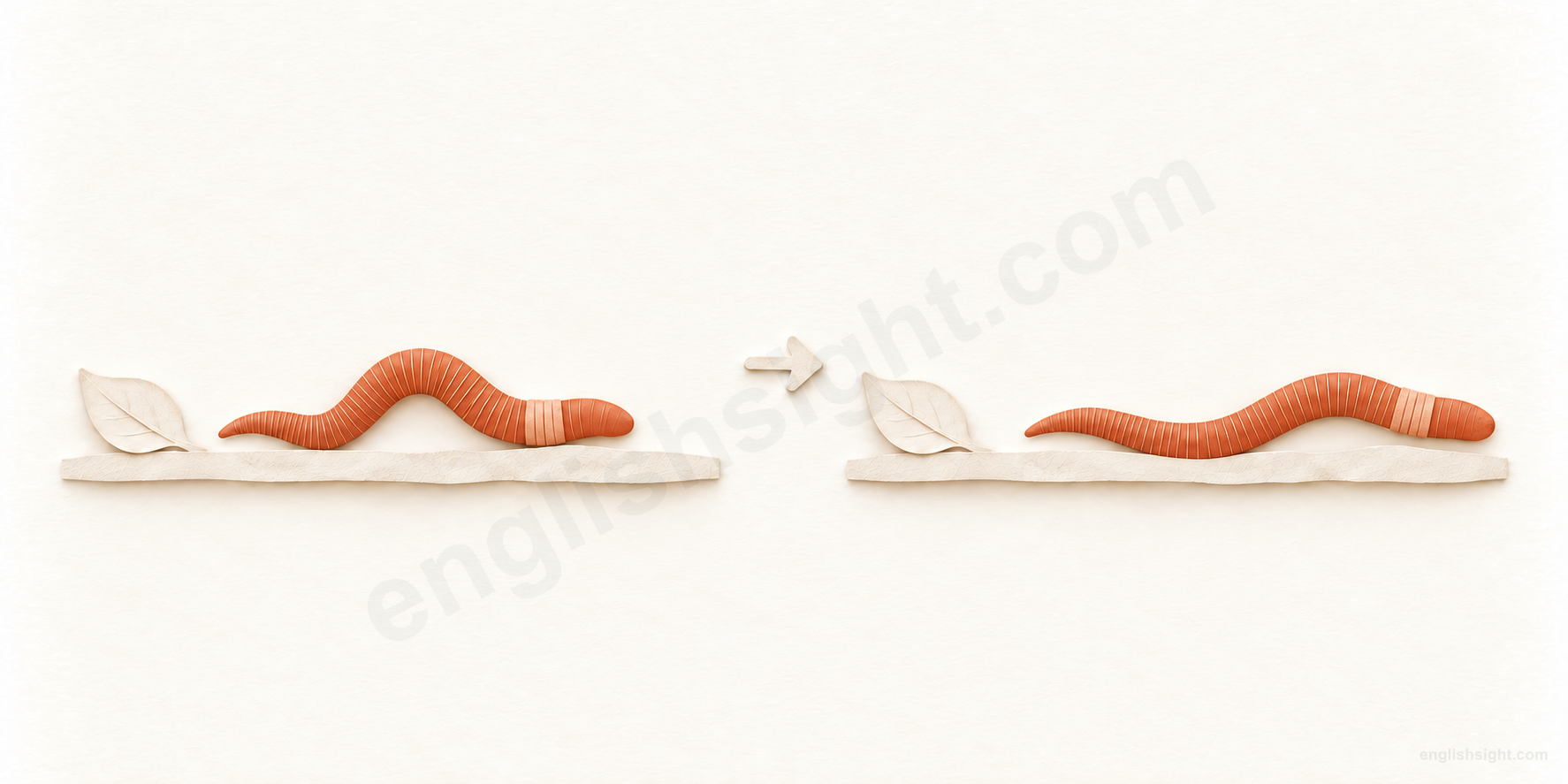
The worm bends its long, soft body beside a fallen leaf.
worm
The same worm is more extended and farther forward relative to the leaf.
Its body changes shape as it wriggles forward.
A flexible body bends and wriggles forward.
A worm has a long, soft body; the movement verb evokes advancing by twisting or wriggling.
This connects the animal and physical movement. Social access and information-seeking are figurative extensions; treatment, computing, insults, and sayings need separate explanations.
A worm is a familiar small creature with a long, soft body. Its shape and wriggling movement offer a useful starting point for understanding the movement verb.
Other uses need their own context: worms in health talk, worm an animal, a computer worm, and fixed sayings. Learn these branches without forcing them all into one picture.
01
Creatures and their names
Start with the animal. In everyday speech, worm can also name a worm-shaped insect larva; it is not one exact scientific category.
01
a / the + worm; number + worms
a worm / worms
a small, long-bodied creature
Situation / starting point
You turn over a little garden soil.
Meaning in context
A soft, narrow animal wriggles into view.
Worm is a countable noun; an earthworm is a familiar example.
Use a worm for one animal and worms for more than one. Worms crawl, wriggle, and burrow; the noun names the creature, while those verbs describe its movements.
Earthworm is a more specific name. Worm does not mean every small garden animal: a beetle or a spider is not normally called a worm.
In a sentence
A worm wriggled under the leaf.
Watch the difference Keep the plural ending: two worms, not two worm.
02
a worm in + food; food + with worms in it
a worm in an apple
a worm-shaped young insect
Situation / starting point
You cut open a piece of fruit.
Meaning in context
You find a small insect larva inside.
Everyday naming by shape is broader than a precise species name.
In food or garden talk, people may call a small, soft, worm-shaped insect larva a worm. A worm in an apple need not be an earthworm.
This is a separate everyday use of the animal name. When the exact kind matters, use the appropriate insect or larva name instead.
In a sentence
There was a tiny worm inside the apple.
Watch the difference Do not infer that all creatures called worms are the same kind of animal.
02
Health, treatment, and computers
The setting changes what worm refers to. Having worms and worming an animal describe opposite sides of a parasite problem.
03
person / animal + have / has worms
have worms
have parasitic worms in the body
Situation / starting point
The conversation is about an animal’s health.
Meaning in context
Worms refers to parasites living inside its body.
Have worms commonly uses the plural without an article.
In a health context, have worms means that parasitic worms are living in a person or animal. It does not mean the animal owns some garden worms.
The plural worms can refer to the infestation rather than to a counted set of individual creatures. This lesson explains the wording, not diagnosis or treatment.
In a sentence
The vet said our puppy had worms.
Watch the difference A dog has worms describes a health problem; a dog has a worm in its mouth describes one held creature.
04
worm + animal; animal + be + wormed
worm a dog
give an animal treatment against worms
Situation / starting point
An animal may carry internal parasites.
Meaning in context
Someone treats the animal against those parasites.
The animal is the object receiving treatment.
As a transitive verb, worm an animal means to treat it to remove parasitic worms. Here the verb points to removing the named thing, not adding it.
The passive is natural: The puppy was wormed. Compare The puppy has worms, which describes the problem. Wormed and worming are regular verb forms.
In a sentence
The rescue centre had wormed the puppy before we adopted her.
Watch the difference Do not read worm a dog as put worms into a dog.
05
a computer / network worm; a worm + spread
a computer worm
a program that copies itself across a network
Situation / starting point
A harmful program reaches one computer.
Meaning in context
Copies spread to other computers on the network.
This is a computing term, not an animal inside the machine.
In computer security, a worm is self-replicating software that spreads across a network. It is countable: a worm, several worms.
This is an established technical label. The useful idea is spreading intrusion; neither the program’s screen appearance nor a literal wriggling shape defines it.
In a sentence
A computer worm spread across the office network.
Watch the difference Worm here does not mean every computer fault or every kind of malicious program.
03
Wriggling, gaining access, and getting information
Bending movement motivates a useful connection to gradual or indirect progress. The full construction tells you whether someone moves, gains trust, or obtains information.
06
worm + my / your / his / her / our / their way + direction; worm + direction
worm your way through / out of
move by twisting through restricted space
Situation / starting point
Your body has little room to move.
Meaning in context
You squeeze and twist until you get through or out.
The subject moves; the possessive matches that subject.
Worm your way through a crowd describes twisting or squeezing forward. Through supplies the route. Worm your way out of a gap describes the exit, supplied by out of.
Change the possessive with the subject: I wormed my way; she wormed her way. The way construction is not a separate literal road. Worm through is also possible without my way.
Unlike crawl, this wording emphasizes winding or wriggling progress. It need not mean moving on hands and knees.
In a sentence
I wormed my way out of the cramped back seat.
Watch the difference Choose the direction for your intended route: through a crowd, into a gap, or out of a tight space.
07
worm + possessive + way / reflexive pronoun + into + relationship / position
worm your way / yourself into
gradually gain someone’s trust or access, often for advantage
Situation / starting point
Someone is outside a trusted relationship or position.
Meaning in context
They gain entry through indirect efforts.
Into identifies the relationship or position being entered.
Worm your way into someone’s confidence suggests gaining trust by subtle, often manipulative efforts. Worm yourself into the group has a similar access meaning.
This is figurative entry, not bodily wriggling. With trust or influence, it usually conveys disapproval; get to know someone is a more neutral description.
Use the matching forms: He wormed himself into their circle; they wormed their way into her confidence.
In a sentence
He wormed his way into the manager’s confidence to get private information.
Watch the difference Do not assume every use with into is figurative: worm into a narrow opening can describe physical movement.
08
worm + information / it + out of + person
worm something out of someone
obtain information through persistent or clever questioning
Situation / starting point
Someone is reluctant to reveal information.
Meaning in context
A questioner eventually gets the information.
The information is the object; the person is its source.
Worm a secret out of someone means to get it by repeated or skillful questioning. It is informal and suggests more effort or indirectness than simply asking.
The pattern is worm + information + out of + person. A pronoun fits in the information slot: I finally wormed it out of him. The questioner is not escaping from the person.
In a sentence
After several gentle questions, I wormed the real reason out of Ben.
Watch the difference Keep both roles clear: worm it out of her, not worm her out of it when you mean obtain information.
04
Judgments, problems, and familiar sayings
These expressions use cultural associations with worms. Learn each whole expression and its tone; the animal sketch cannot predict the meaning.
09
call + person + a worm; person + be + a worm
call someone a worm
express contempt for a person
Situation / starting point
A speaker judges someone’s character harshly.
Meaning in context
The speaker uses a degrading animal comparison.
A worm used of a person is an insult.
Calling a person a worm expresses lack of respect, often suggesting weak or unpleasant character. It is informal and disapproving, not a neutral personality description.
The evaluation is an established figurative use. The animal’s actual value or behavior does not justify the judgment.
In a sentence
In the argument, she called him a worm for betraying his friend.
Watch the difference Calling someone a worm can offend; it does not simply mean that they are small or quiet.
10
open (up) + a can of worms; be + a can of worms
open (up) a can of worms
start dealing with a subject that brings tangled problems
Situation / starting point
A question looks simple enough to raise.
Meaning in context
It brings up many difficult, connected issues.
The whole expression identifies a troublesome situation.
Open a can of worms means to raise or start something that creates or reveals complicated problems. Open up a can of worms is a common variant.
You can also say The new rule is a can of worms. The mental connection is a difficult-to-control tangle, not one animal’s forward motion.
In a sentence
Changing that clause could open a can of worms about every earlier contract.
Watch the difference Use the fixed plural worms. A can of worm is not the idiom.
11
The early bird catches the worm.
the early bird catches the worm
acting before others can give you an advantage
Situation / starting point
Several people want the same opportunity.
Meaning in context
The one who acts first has the advantage.
The proverb compares an opportunity to food found early.
Use this saying to encourage early action: applying, arriving, or booking before others. It need not refer to waking up early.
The bird is the person taking the opportunity, and the worm is the benefit. This is advice about timing, not a promise that the first person always succeeds.
In a sentence
We booked before the cheap seats sold out—the early bird catches the worm.
Watch the difference Keep the full saying recognizable; catches agrees with the singular bird.
12
the worm + turns / will turn / has turned
the worm turns / will turn
a usually submissive person finally resists
Situation / starting point
Someone has quietly accepted bad treatment.
Meaning in context
They reach a limit and begin to resist.
Turning marks a reversal in the person’s response.
The worm turns describes someone who normally accepts mistreatment finally protesting. The worm will turn can warn that even a very patient person has limits.
The tense follows the situation: The worm has turned announces the change. This traditional saying is useful for recognition in stories or commentary; it does not describe just any change of luck.
In a sentence
After years of accepting unfair shifts, Leo refused: the worm had turned.
Watch the difference Do not read this as an actual animal changing direction or as a synonym for every reversal.
Keep the noun, verb, and fixed expression apart
Regular forms, different roles
The noun has the plural worms. The verb forms are worm, worms, wormed, wormed, and worming. In The dog has worms, worms is a noun; in She worms the dogs, worms is a verb.
Read the whole construction
I wormed my way out of a seat describes my movement. I wormed the truth out of someone describes obtaining information. Worm someone into trusting me is not the standard pattern taught here; use I wormed my way into their confidence.
A model with limits
The sketch links the animal to winding movement. It does not predict all idioms or suggest that every English speaker imagines the same picture. Not every occurrence of worm plus a preposition is a fixed phrasal verb.
Scope
This lesson covers modern everyday senses and useful expressions, with the traditional worm turns saying for recognition. Specialized machinery, nautical rope work, historical serpent or dragon senses, and a full catalogue of compound words are outside this lesson.
Follow the roles and the context
Choose the expression that fits the situation.
1. A record says the puppy was wormed. What happened?
2. You eventually persuaded Jo to reveal a secret. Which sentence gives the intended roles?
3. You twist sideways to get out of a cramped seat. Which phrase fits?
4. Someone gradually wins a manager’s trust to gain an unfair advantage. Which wording signals disapproval?
5. You act before others and secure a limited opportunity. Which saying fits?
Sources and teaching notes
The sources below support the senses and constructions. Explanations and examples are original; the visual connection is a teaching aid.
The diagram connects shape and movement; it does not represent one image shared by all speakers.