Name a physical wound, describe emotional hurt, and recognize the different wound from wind.
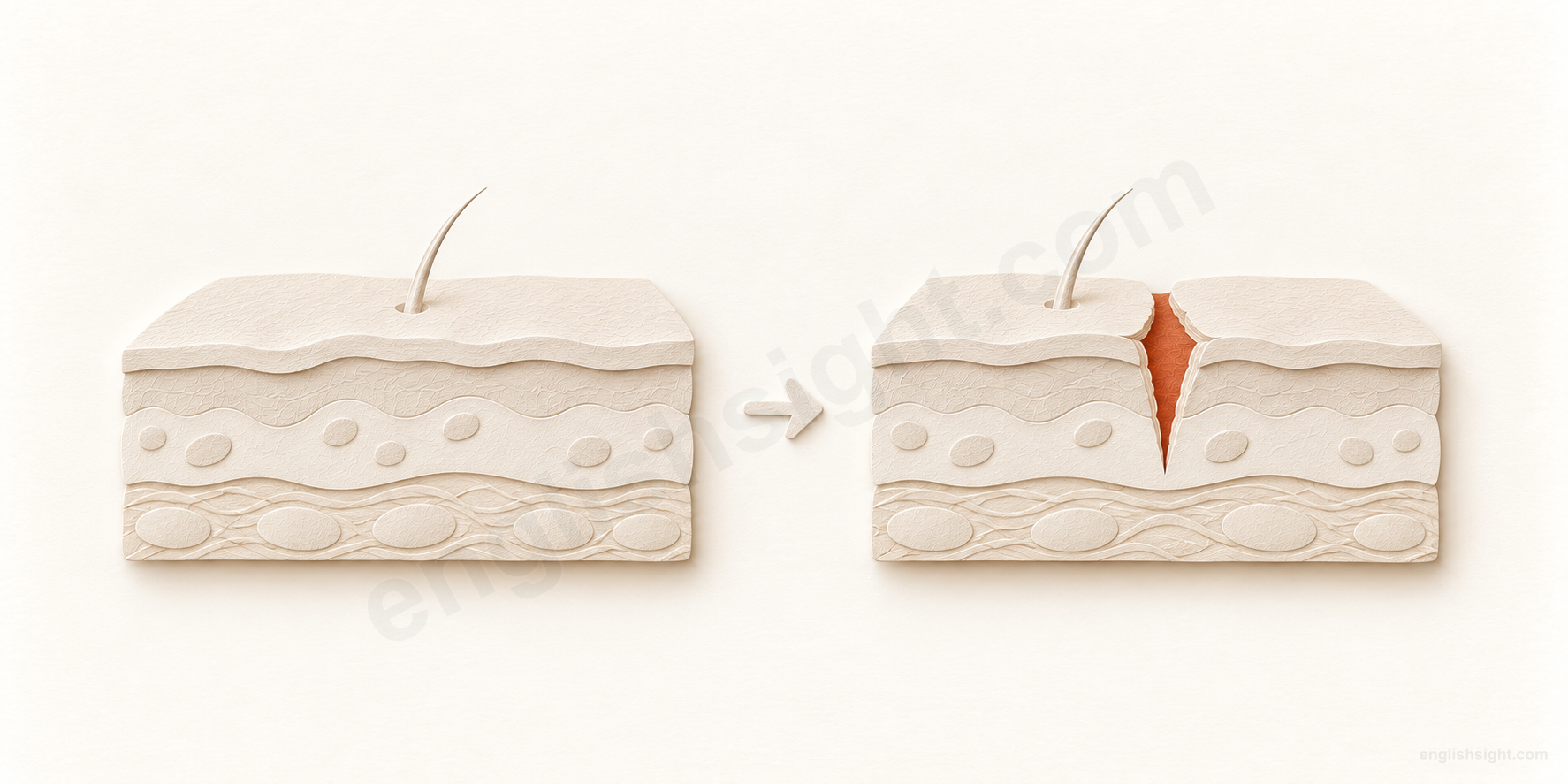
From intact tissue to an injured place
From intact tissue to an injured place
The skin surface and the tissue beneath it are intact.
wound
A narrow wound remains where the tissue is broken.
An injury breaks the surface and underlying tissue.
The damaged place is a wound; to wound is to cause the injury.
A physical wound is an injury that typically involves cut or broken living tissue; the verb wound means cause such injury. Figurative uses describe hurt to feelings or relationships.
The picture shows one typical physical wound. It does not make every injury a wound, predict the idioms, or explain wound /waʊnd/, the separate past form of wind.
A wound /wuːnd/ can be the injury itself; to wound is to cause that injury. English also uses this injury image for feelings, pride, and relationships.
The diagram follows one physical relation: intact skin becomes broken tissue. It is a teaching model for connecting uses, not a claim that every English speaker has the same mental picture.
01
Physical injury: the damage and its cause
Name a wound, locate it, describe its recovery, and distinguish the injured person from the injury.
01
a wound on / to + body part; have / suffer / receive + a wound
a wound / wounds
an injury involving damaged living tissue
Situation before
A piece of glass cuts the skin.
What it means here
There is an injured area on the hand.
The noun names the resulting injury, not the object that caused it.
Use a wound for one injury and wounds for more than one. Have, suffer, and receive can introduce the injury: he has a wound; she suffered several wounds. The physical noun is countable.
A cut or puncture is a typical wound. Accidents and surgery can cause wounds too; the word is not restricted to combat. A wound on her hand or a wound to her hand locates the injury.
Injury is broader. A sprained ankle is an injury, but we would not normally call that a wound. For a small everyday cut, I cut my finger often sounds more natural than I wounded my finger.
In a sentence
She had a small wound on the back of her hand.
Watch the difference Do not use wound as the name for every ache, illness, bruise, or sprain.
02
adjective / cause noun + wound; a wound to + body part
an open wound / a deep wound
describe the condition, depth, or cause of an injury
Situation before
An injury is being described.
What it means here
The listener knows what kind of wound it is.
The modifier supplies information that wound alone does not give.
Open wound draws attention to a break in the tissue; deep wound describes depth. Neither expression by itself names the cause. A stab wound, gunshot wound, or surgical wound identifies how the injury was made.
A wound to the shoulder locates the injury. Wounded in the shoulder describes the injured person. In and to belong to these larger patterns; they do not create new senses of wound.
In a sentence
The report described a deep wound to his shoulder.
Watch the difference An open wound is not simply any visible mark. A scar can remain after a wound has healed.
03
a wound heals; treat / clean / dress a wound; wound care
the wound is healing / treat a wound
talk about repair and care
Situation before
The tissue has been injured.
What it means here
The tissue is healing or the wound is receiving care.
Healing is recovery; treatment is action intended to help.
The wound is healing makes the wound the subject of heal. Someone treats, cleans, or dresses a wound makes a person the subject and the wound the object. Dress a wound means clean it and apply a protective covering, not put clothes on it.
Wound care is a noun combination meaning care of wounds. Wound stays singular as a modifier even when several wounds are involved. A wound may leave a scar after healing; wound and scar describe different stages.
In a sentence
The nurse checked how the wound was healing.
Watch the difference The wound healed describes recovery. The nurse wounded him would say the nurse caused an injury.
04
wound + person; be wounded (by + cause) (in + body part)
wound someone / be wounded
cause or receive a physical wound
Situation before
An explosion sends out pieces of metal.
What it means here
People have been injured by them.
The active subject causes the wound; the passive subject receives it.
Wound is commonly transitive: something wounds someone. In the passive, someone is wounded by something. News reports often contrast people killed with people wounded.
The regular forms are wound, wounds, wounded, wounding. All use the vowel /uː/, as in food. Seriously, badly, and slightly wounded indicate severity; wounded in the leg gives the location.
For ordinary mishaps, hurt or injure is often the more general choice. I hurt my knee does not necessarily describe broken skin, whereas physical wound usually suggests damaged or broken tissue.
In a sentence
Two passengers were wounded by flying glass.
Watch the difference The injury verb has the past form wounded, not wound: the glass wounded her yesterday.
05
a wounded + person noun; the wounded + plural verb
wounded people / the wounded
refer to people who have been wounded
Situation before
Several people need help after an attack.
What it means here
A report refers to the injured group.
Wounded can describe people; the wounded names a group of them.
A wounded passenger is one person with injuries. The wounded means wounded people as a group and takes a plural verb: the wounded were taken to hospital.
The wounded does not name the wounds themselves. Compare the wounded were waiting with the wounds were healing. To name one individual, use a wounded person, not a wounded.
In a sentence
The wounded were taken to a nearby hospital.
Watch the difference The wounded are people; their wounds are injuries.
02
Hurt feelings and damaged relationships
English extends bodily injury to emotional pain, pride, and divisions between people. These uses can sound more vivid or serious than everyday hurt.
06
an emotional wound; the wounds of + experience / time
an emotional wound
a hurt that an upsetting experience leaves
Situation before
Someone experiences betrayal.
What it means here
The emotional hurt remains after the event.
Emotional pain is described through the image of a bodily injury.
An emotional wound is not broken skin. It presents hurt from an experience as damage that may need time to recover. Emotional wounds and the wounds of the past are familiar ways to develop this image.
This is vivid language and can sound reflective or literary. In a simple conversation, that really hurt me may be more natural than that left an emotional wound. The metaphor does not mean emotional pain is literally a cut.
In a sentence
Years later, the betrayal was still an emotional wound.
Watch the difference A wound can be figurative; do not look for a physical injury when the context concerns feelings.
07
wound + person / someone’s pride; feel wounded; be wounded by + words / action
wound someone’s pride / feel wounded
hurt someone emotionally or damage their self-respect
Situation before
A dismissive remark is made.
What it means here
The listener feels personally hurt.
The thing being injured can be a person’s feelings or pride.
His remark wounded her uses the same object pattern as the physical verb, but the context makes the injury emotional. Wound someone’s pride makes self-respect the explicit object.
She felt wounded describes her emotional state. She was deeply wounded by the comment presents the hurt and its cause. These forms usually sound stronger or more vivid than slightly annoyed.
A wounding remark is a remark that hurts. A wounded person is the one affected: -ing describes the cause here, while -ed describes the person’s resulting state.
In a sentence
His public correction wounded her pride.
Watch the difference Wounded can be emotional or physical; the surrounding words decide. It does not simply mean angry.
08
heal the wounds of + conflict / event; wounds heal
heal the wounds of a conflict
repair hurt and divisions between people
Situation before
A dispute has divided a family.
What it means here
People try to rebuild friendly relations.
The injury image can extend from one person to a relationship or community.
Heal the wounds of a dispute describes repairing its emotional and social effects. The wounds can also be the subject: the wounds have not healed yet. The choice of heal supplies the recovery meaning.
An agreement may end a dispute without healing every wound. The phrase concerns damaged trust and feelings, not just signing a document; recovery is not guaranteed by the word wound.
In a sentence
The family hoped to heal the wounds of their long dispute.
Watch the difference Do not assume the conflict has ended merely because someone hopes to heal its wounds.
09
a self-inflicted wound
a self-inflicted wound
damage brought about by the affected person or group
Situation before
A business makes a damaging decision.
What it means here
It suffers a problem of its own making.
Self-inflicted identifies the same party as source and sufferer.
In literal use, self-inflicted describes an injury someone deliberately causes to themselves. In commentary, a self-inflicted wound can instead be a damaging mistake made by the very person or organization that suffers.
The business metaphor does not say the bad outcome was intended. It criticizes a choice as causing avoidable harm. The compound adjective has a hyphen before the noun.
In a sentence
Ignoring its regular customers was a self-inflicted wound for the shop.
Watch the difference The figurative business use does not imply physical injury or an intention to suffer.
03
Three familiar injury metaphors
Learn the whole expression: bringing pain back, making it worse, or recovering after defeat. These are not phrasal verbs built from wound.
10
open / reopen old wounds
open / reopen old wounds
bring back pain from an earlier upsetting experience
Situation before
A painful family argument is no longer being discussed.
What it means here
Mentioning it makes the old hurt active again.
Old refers to the earlier hurt; reopen brings it back.
Reopen old wounds means cause someone to remember and feel hurt by a painful past experience again. Open old wounds has the same idiomatic use. A conversation, question, or event can do this without intending to.
The metaphor uses the idea of an injury becoming open again. Learn the whole expression; reopen is the verb and wounds is its noun object. This is not a phrasal verb of wound.
In a sentence
I did not mention the argument because I did not want to reopen old wounds.
Watch the difference In a literal medical context, reopen a wound can mean an actual wound opens again; old wounds in a family conversation usually points to emotional hurt.
11
rub salt into / in the wound
rub salt into / in the wound
make an already painful situation worse
Situation before
A team has just lost a match.
What it means here
Someone mocks the mistake that caused the loss.
The extra action aggravates pain that already exists.
Rub salt into the wound and rub salt in the wound describe an additional blow, reminder, or unkind comment that makes an unpleasant situation worse. They often concern failure or humiliation.
The wound is the earlier trouble; the salt is the added aggravation in this metaphor. No actual salt or injury is required. To rub salt into the wound can introduce a further bad detail in a story.
In a sentence
Laughing at their final mistake only rubbed salt into the wound.
Watch the difference This means worsening existing pain. Reopen old wounds instead emphasizes reviving hurt from the past.
12
lick + possessive + wounds
lick your wounds
recover emotionally after defeat or disappointment
Situation before
A candidate loses an election.
What it means here
They take time to recover from the setback.
The whole expression describes recovery after a blow.
Lick your wounds means spend time recovering after a defeat, humiliation, or disappointment. The possessive follows the person or group: I lick my wounds; they lick their wounds.
A team can go home to lick its wounds without anyone being physically injured. The expression often suggests retreating for a while to recover; it does not necessarily mean giving up permanently.
In a sentence
After losing the final, the team went home to lick its wounds.
Watch the difference This is an idiom about recovery after a setback, not an instruction for caring for an injury.
04
The other wound: a different word
Spelling alone does not choose the pronunciation. Wound can also be a past form of wind, with no injury meaning.
13
wind–wound–wound; wound + object + around + thing
wound the string around…
the past form of wind: wrap or coil
Situation before
A length of string is loose.
What it means here
Someone wraps it around a piece of card.
This wound has the vowel /aʊ/, as in found, and belongs to wind.
Wind /waɪnd/ has the past tense and past participle wound /waʊnd/: she wound the string around the card; she has wound it around the card. This is a different word from injury wound /wuːnd/.
Compare the glass wounded him with she wound the string. The first past form ends in -ed and means caused an injury; the second has no -ed and means wrapped. Wound up can likewise come from wind up, not from the injury verb.
The noun wind meaning moving air has /ɪ/, as in sit. The wrapping verb here has /aɪ/, as in find. Other senses and phrases of wind belong to the wind lesson.
In a sentence
She wound the string around a piece of card.
Watch the difference Do not pronounce the injury noun like found, or use wound as the past of the injury verb.
Choose the word and the construction
Wound, injury, hurt, and scar
Injury covers many kinds of bodily damage. Physical wound usually points to cut or broken tissue. Hurt is a broad everyday verb for physical or emotional pain. A scar is a mark left after tissue heals; a scar is not an open wound.
Two pronunciations and two past forms
Injury: wound /wuːnd/, wounded /ˈwuːndɪd/, wounding /ˈwuːndɪŋ/. Wrapping: wind /waɪnd/, wound /waʊnd/, wound /waʊnd/. The spelling matches but the meanings and grammar differ.
Scope of this lesson
The focus is modern bodily and emotional uses and familiar idioms, with the wind form included for recognition. Plant-tissue wounds are a related specialist use. Detailed wound classifications, obsolete pronunciations, and the full wind phrase family are outside this lesson. A fixed expression must be learned as a whole.
Read the whole expression
Use the situation, grammar, and pronunciation to choose the interpretation.
1. Glass caused an injury to her arm yesterday. Which past form fits?
2. In a report, what does The wounded were moved to safety refer to?
3. A question makes someone remember a painful argument from years ago. Which expression emphasizes that return of old hurt?
4. You lost a competition, and a friend keeps mocking your mistake. What is the friend doing?
5. In She wound the string around the card, how does wound sound?
Sources and teaching notes
The publisher entries below were consulted for meanings and usage. The explanations and examples are original; the diagram connects selected uses as a teaching model. Collocation pages provide usage evidence rather than a frequency ranking.
The diagram supports a meaning connection; speakers do not all share one fixed mental picture.