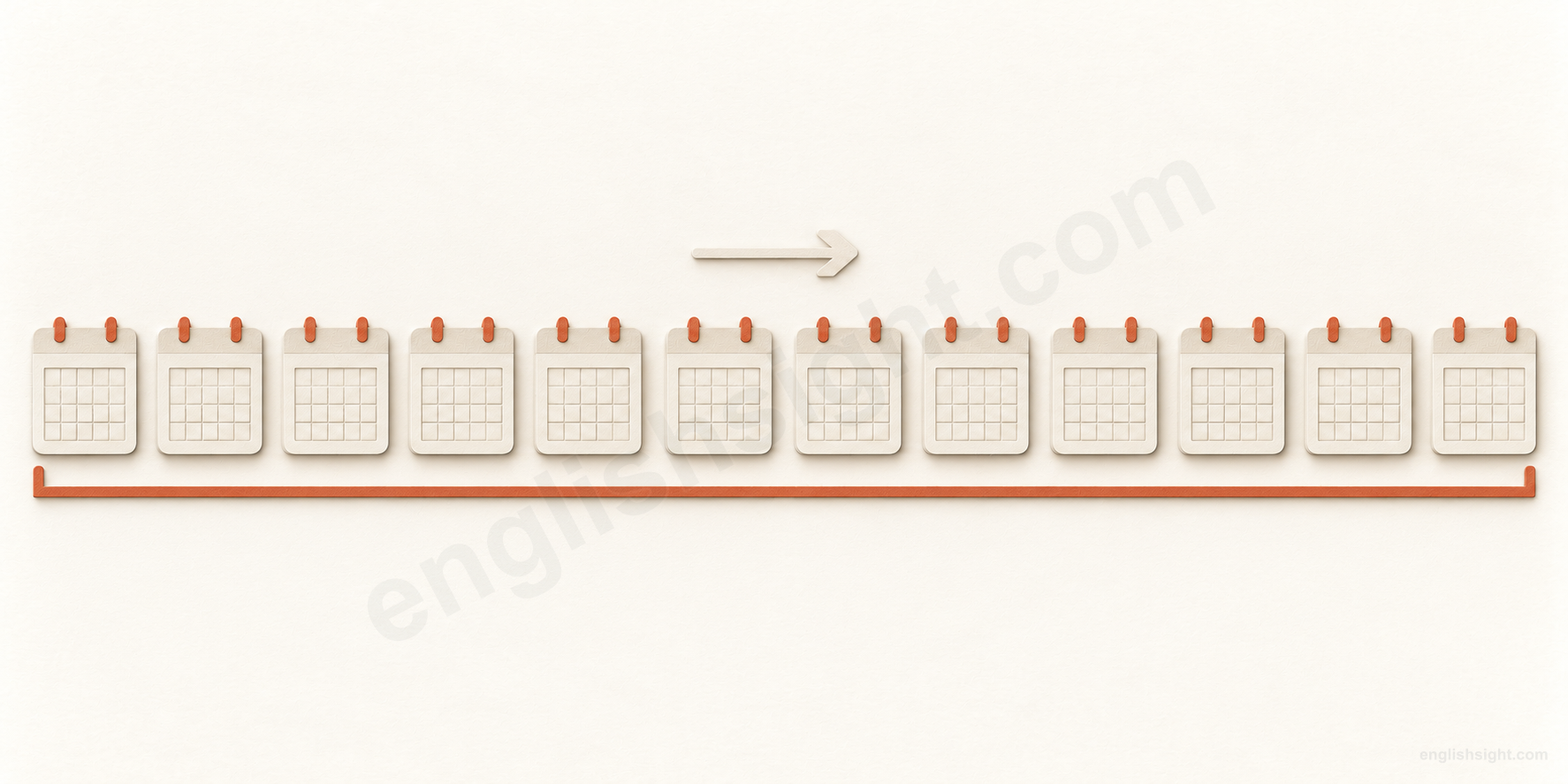
Use year to date events, measure intervals, describe age, and organize recurring activity.
Group time into an annual unit
Group time into an annual unit
The left end of the bracket marks a chosen starting point.
year
The right end marks the completion of one measured year.
Time passes through twelve consecutive months from left to right.
Twelve months make one measured year, counted from a chosen starting point.
A year groups time into an annual unit: normally twelve months, which can be named, counted, or used to organize an activity.
The diagram illustrates a twelve-month interval. A calendar year fixes its boundaries at January and December; a school year instead names an annual teaching session, which may contain fewer months of classes. Figurative expressions require their own explanations.
Year is usually a countable noun. Its plural is years. It can name a calendar unit, measure an interval, or organize an annual activity such as study or accounting. The surrounding words tell you which job it is doing.
A useful teaching model is to group time into one annual unit, normally twelve months. We can name that unit, count it from a chosen date, or use it to organize a cycle. The model helps connect uses; it is not a claim about a picture shared by all English speakers.
01
A named year or a measured interval
A year can identify a place on the calendar or measure how much time passes. The starting point matters.
01
in + year number; in the year + number; at / by the end of the year
in 2026 / the year 2026
identify a numbered calendar year
Starting context
You need to date an event.
What the expression tells us
The event is placed inside a particular calendar year.
A numbered year is a calendar location, not a duration.
A calendar year runs from January 1 through December 31 in the Gregorian calendar. A number such as 2026 identifies one of these units. Use in with the number: in 2026; the year is optional in in the year 2026.
At the beginning of the year and at the end of the year select parts of a known annual period. By the end of the year gives a deadline. This time of year means the season or part of the annual cycle we are now in; it need not name one numbered year.
In a sentence
The new library opened in 2026.
Watch the difference Say in 2026, not on 2026. On introduces a particular day, as in on January 4.
02
a / one year; number + years; half a year; a year and a half
a year / half a year
measure an interval of twelve months
Starting context
The lease starts in May.
What the expression tells us
It ends twelve months later, in May.
A measured year can begin on any date.
A year can mean a twelve-month interval rather than January through December. A lease lasting a year might start in May. A year from today reaches the corresponding date next year.
The ordinary countable forms are a year, one year, two years, and several years. Half a year measures six months; a year and a half measures eighteen months. A whole year emphasizes the entire interval. The noun counts time without telling us what happened during it.
In a sentence
Our lease runs for a year from May.
Watch the difference Use a year, because year begins with the consonant sound /j/. Do not write an year.
03
a leap year; in a leap year
a leap year
name a calendar year with an extra day
Starting context
An ordinary Gregorian year has 365 days.
What the expression tells us
February 29 makes a leap year 366 days long.
The calendar sometimes needs an extra day.
Leap year is the established name for a Gregorian calendar year containing February 29. It has 366 days, while an ordinary year has 365. Both still have twelve months.
Such years normally occur four years apart, with century exceptions: a century year must be divisible by 400 to be a Gregorian leap year. The phrase does not mean a year that feels fast or a large improvement.
In a sentence
February has twenty-nine days in a leap year.
Watch the difference Do not treat every four-year interval as an exceptionless rule; century years need the additional check.
04
Happy New Year!; on New Year’s Day / Eve; in the new year
Happy New Year! / New Year’s Day
refer to the beginning of a new calendar year
Starting context
One calendar year is ending.
What the expression tells us
People greet the next year and mark its opening day.
The holiday expression and an ordinary new annual period overlap.
Happy New Year! is a greeting for the year beginning. New Year’s Day names its opening holiday, January 1 in the Gregorian calendar; New Year’s Eve is the evening or day before it. New Year’s Day and New Year’s Eve use capitals and a singular possessive apostrophe; the greeting Happy New Year has no apostrophe.
We will meet in the new year usually looks ahead to the coming year or its early part. A new school year can begin in another month. Other calendars also have new-year celebrations; the context must identify the calendar.
In a sentence
We are visiting my aunt on New Year’s Day.
Watch the difference The greeting is Happy New Year, not Happy New Years. Keep the apostrophe in New Year’s Day.
02
Locating events and measuring time
Prepositions, determiners, and numbers tell us whether we mean duration, a future point, a past point, or a repeating rate.
05
last / this / next year; for the last year; the next year
last year / this year / next year
locate a year relative to now
Starting context
You are speaking during one calendar year.
What the expression tells us
Last and next select its neighbors; this selects the current one.
These determiners usually make a complete time expression.
Last year points to the preceding year, this year to the current one, and next year to the following one. They normally take no preposition: We moved last year; We will move next year.
The last year is different: I have worked here for the last year refers to the twelve months leading up to now. The next year can be a year following a past reference point: She arrived in June and left the next year. Last and next do not always measure twelve months from today.
In a sentence
We moved last year, and we plan to buy a home next year.
Watch the difference Do not add in before bare last year, this year, or next year. Compare in the next year, which has a determiner phrase.
06
for + number + years; since + year number
for two years / since 2024
state a duration or its starting point
Starting context
An activity starts and continues through time.
What the expression tells us
You report either its length or the date it began.
For measures an interval; since identifies its beginning.
For two years answers How long? If the situation continues now, use a suitable present perfect: I have lived here for two years. A past simple can describe a finished period: I lived there for two years, then moved.
Since 2024 identifies a starting point, not a quantity of time. Years alone does not select a tense: the surrounding clause shows whether the period is finished, ongoing, or planned. A planned stay can be I am going away for a year.
In a sentence
I have worked at this café for two years.
Watch the difference Say for two years, not since two years. Use since with a starting point such as 2024.
07
complete / finish / build + object + in a year
finish in a year
measure the time needed to reach completion
Starting context
The renovation begins.
What the expression tells us
It is complete after twelve months of work.
With a completed task, in can measure how long the task takes.
They renovated the house in a year measures the interval from beginning to completion. It answers How long did it take? Compare They worked on the house for a year, which describes a duration and does not by itself say the work was finished.
A year is the time measure in both sentences; the verb and preposition give the completion contrast. In a year is not a special new sense of the noun and does not always mean a future delay.
In a sentence
The team built the bridge in a year.
Watch the difference For a year can measure activity without completion; in a year can measure the time required to finish.
08
in a year; in a year’s time; within a year
in a year / in a year’s time
locate something about twelve months from now
Starting context
Today is the reference point.
What the expression tells us
The planned event is one year later.
Here in measures a delay before a future event.
I will call you in a year places the call roughly twelve months after now. In a year’s time expresses the same future distance. Next year instead usually identifies the following calendar year, so the wait could be much shorter or longer than twelve months.
Within a year sets an outer limit: the event can happen sooner, but no later than a year after the relevant starting point. In a year can also measure completion time with a task verb; use the whole sentence to choose the reading.
In a sentence
We will review the plan in a year’s time.
Watch the difference In a year and for a year are different: one can locate a future event; the other gives its duration.
09
a / number + year(s) ago; a year earlier / before
two years ago / a year earlier
locate an event before a reference point
Starting context
Now, or a past event, supplies the reference point.
What the expression tells us
You count backward by a stated number of years.
Ago normally looks back from now; earlier can look back from another time.
Two years ago means two years before now and commonly appears with a past tense: We met two years ago. It locates an event rather than saying the event lasted two years.
Earlier or before can compare with a past reference point: When I arrived in 2026, she had moved there a year earlier. Do not mechanically use ago when the intended reference point is a different past date.
In a sentence
I bought this bicycle three years ago.
Watch the difference Compare I used it for three years: that states length of use, not the date of purchase.
10
once / twice a year; amount + a / per year; every year; every two years / every other year
twice a year / every year
state a yearly rate or repeated schedule
Starting context
You count visits or costs across an annual interval.
What the expression tells us
The amount or event recurs at that rate.
A year can mean per year after a number or amount.
Twice a year means two times per year. A membership costing sixty dollars a year has an annual price of sixty dollars; per year is a more formal alternative. Every year and each year say that an event happens in each annual unit.
Every two years and every other year mean once in each two-year cycle. They do not mean twice a year. These expressions state a rate or schedule, while for two years gives the length of a period.
In a sentence
We inspect the roof twice a year.
Watch the difference After every, use singular year in every year but plural years after a number: every three years.
11
all year; all year round; all the year round; year-round + noun; operate / be open + year-round
all year round / year-round
say something continues across the seasons
Starting context
A service might be limited to one season.
What the expression tells us
It remains available throughout the annual cycle.
Round emphasizes coverage of the whole year, not one visit each year.
All year round and all the year round mean throughout the year. A pool open all year round stays available across seasons; it is not merely open once each year.
All year can also describe an entire particular year: She studied abroad all year. The all-year-round expression often stresses seasonal availability. This is a time expression, not a particle verb and not a literal circular route.
Year-round is also an adjective and an adverb meaning throughout the year: The pool offers year-round swimming; The pool is open year-round. The adjective describes availability across seasons, not how often someone visits. The longer adjective all-year-round can also appear before a noun, as in all-year-round access.
In a sentence
The island’s visitor centre is open all year round.
Watch the difference Every year says how often something recurs. All year round says it extends throughout the year.
03
Age, experience, and life periods
Counting years lets us describe age and experience. Plural years can also name a meaningful stretch of life.
12
be + number + years old; number + years of age
six years old
measure age in completed years
Starting context
A child has a birthday.
What the expression tells us
Six annual intervals have passed since birth.
Age counts elapsed years from birth or creation.
She is six years old states her age; How old is she? asks for it. The same pattern works for objects and institutions: The building is eighty years old. Six years of age is a more formal alternative.
When age is already clear, She is six is enough. Use be in the ordinary age statement, not have. Six years old normally counts completed years; in her sixth year describes the interval before her sixth birthday and is not the same wording.
In a sentence
My daughter is six years old.
Watch the difference Use one year old but two years old. Year is singular only when the number is one in this pattern.
13
a number-year + noun; a number-year-old + noun; a number-year-old
a six-year-old / a two-year course
use an age or duration as a modifier
Starting context
You want a compact description before a noun.
What the expression tells us
The measure becomes part of one compound description.
Year is singular inside a number-based compound modifier.
Compare The course lasts two years with a two-year course. Before the noun, the compound uses singular year and normally hyphens. This describes duration; it does not say the course happens twice a year.
A six-year-old child describes age. A six-year-old can also name the child without repeating child; two six-year-olds takes its plural ending at the end of the whole noun. Compare The children are six years old, where the measure is not a compound before a noun.
In a sentence
They offer a two-year course for adults.
Watch the difference Write a two-year course, not a two-years course. Write six years old after be without those hyphens.
14
a year’s + noun; number + years’ + noun; years of experience
a year’s experience / two years’ experience
connect an amount of time with experience or a related quantity
Starting context
Work over time adds up to experience.
What the expression tells us
You describe its amount in years.
The possessive ending connects a time measure to the following noun.
A year’s experience means experience gained over one year; two years’ experience means experience gained over two years. The apostrophe follows singular year before s, but follows the plural s in years’. Two years of experience is an equally clear alternative.
A year’s work is work associated with that amount of time. This construction does not require time to own anything literally. Compare a two-year course, a compound modifier with no possessive apostrophe, and in a year’s time, the future-time expression.
In a sentence
The job requires two years’ experience in customer service.
Watch the difference Do not confuse two years’ experience with two year’s experience: the measure is plural.
15
early / later years; years as + role; years in + place; over the years
her early years / years as a teacher
name a meaningful period of life or activity
Starting context
A person spends time in a role or place.
What the expression tells us
Those years are remembered as one period.
Plural years can identify a phase without giving an exact count.
Her early years often refers to childhood; her later years refers to the later part of her life. The context determines the boundaries. Years as a teacher and years in Berlin identify a period by role or place.
During those years points inside a previously mentioned period. Over the years looks across the passage of time, often with gradual change: We have become close friends over the years. The noun does not itself imply either a happy or difficult period.
In a sentence
She learned to repair bicycles during her years as a mechanic.
Watch the difference Years as a mechanic identifies a life or work period; years old measures age.
16
wise / mature beyond someone’s years; young for someone’s years; a person of someone’s years
wise beyond her years / for his years
compare someone’s qualities with expectations for their age
Starting context
You know someone’s age and behavior.
What the expression tells us
You compare the behavior with age-based expectations.
Years can stand for age in an evaluative expression.
Wise beyond her years describes judgment that seems unusually mature for someone of her age. Young for his years means young-looking or youthful compared with what might be expected at that age.
A person of her years is a more formal way of referring to someone of her age, often in an age comparison. These are assessments, not exact measurements; expectations about age depend on the speaker and situation.
In a sentence
Leah is only twelve, but her advice is wise beyond her years.
Watch the difference Beyond her years does not mean she has literally lived extra years. Avoid assuming that the phrase supplies an exact age.
04
School and accounting calendars
Organizations set their own annual boundaries. A school year, a student year group, and a financial year have different functions.
17
school / academic year; in one’s first / second / final year; repeat a year
the school year / her second year
organize an annual cycle or stage of study
Starting context
A course has a teaching schedule and several stages.
What the expression tells us
Year identifies the annual session or a stage within the course.
A teaching year can be shorter than twelve months.
The school year or academic year is the institution’s annual teaching period. Its dates depend on the education system and institution; do not assume it begins in January or has twelve months of classes.
She is in her second year means she is at the second annual stage of her course. Her final year is the last stage. Repeat a year means study at the same stage again. A two-year course measures the overall planned duration rather than naming one teaching session.
In a sentence
He is in his final year at university.
Watch the difference A school year is not necessarily January to December. In her second year describes a study stage, not her age.
18
be in someone’s year; the whole year; first years; first-year students
my year / the first years
refer to students at the same annual stage
Starting context
A school divides students into annual stages.
What the expression tells us
Year can name the students in one of those stages.
The annual unit can stand for a group of people, especially in British usage.
In British educational usage, my year can mean the students at the same stage as me: She is in my year at school. The whole year can refer to all the students in that group rather than a span of time.
First years can refer to students in their first year, especially in Britain. This is a people sense. A first-year student uses a compound modifier; a first year can stand for the person when the context is clear. Grade or class may be the natural label in another education system.
In a sentence
The whole year attended the school assembly.
Watch the difference School-year and grade numbers differ across systems; do not assume Year 7 names the same age group everywhere.
19
financial / fiscal year; the year ending + date
financial year / fiscal year
set an annual period for accounts or budgets
Starting context
An organization chooses an accounting start and end.
What the expression tells us
Results are grouped inside that annual period.
An accounting year need not match the calendar year.
A financial year or fiscal year is an annual accounting period for reporting income, spending, budgets, or financial results. It can begin in a month other than January. Fiscal year is especially familiar in American accounting usage; financial year is common in British usage.
The year ending June 30 identifies the period by its closing date. Do not guess the starting date from the word year alone: read the report’s stated dates. A year label in a report may follow that organization’s accounting convention.
In a sentence
The charity’s financial year ends in June.
Watch the difference Financial year and calendar year may cover different dates, even when their labels use the same number.
20
take a year off + work / study; take a gap year
take a year off / take a gap year
spend an annual interval away from usual work or study
Starting context
Study or work normally continues from one stage to the next.
What the expression tells us
A person pauses that activity for about a year.
Off marks absence from an activity; gap names a break between stages.
Take a year off work means arrange a year away from work. Year gives the duration, and off work identifies what is paused. It does not necessarily mean doing nothing: the person might travel, study, or care for family.
A gap year commonly names a break between leaving school and starting college or university, a familiar British educational expression. Take a gap year states the decision to have that break. Do not confuse take a year off work with a holiday that takes years off you: the latter means it makes you look or feel younger.
In a sentence
Maya took a gap year before starting university.
Watch the difference A gap year is a break in an educational path, not an academic year with missing lessons. A year off work does not automatically mean paid leave.
05
Repetition, change, and figurative age
Learn the whole expression: after, by, round, on, and off create useful contrasts that the noun alone does not supply.
21
for years; take years; years and years; not / best … in years
for years / not in years
emphasize a long time
Starting context
You remember a long interval without counting it exactly.
What the expression tells us
Years highlights how long it feels or has lasted.
Plural years can be approximate or emphatic.
I have known her for years can leave the number unstated while emphasizing a long friendship. It took years stresses a lengthy process. Years and years adds emphasis; in a frustrated remark the length may be exaggerated.
I haven’t seen her in years means no meeting has happened for a long time; for years also works in that negative statement. The best meal I have had in years compares this meal with meals over a long recent period. In years in these contexts is not a promise about a future date.
In a sentence
I haven’t visited that beach in years.
Watch the difference Years need not be an exact count, but do not assume every use is exaggeration. Two years usually gives a specific measure.
22
year after year; year in, year out; year in and year out
year after year / year in, year out
emphasize recurrence across successive years
Starting context
An event recurs in one year, then the next.
What the expression tells us
You emphasize the repeated pattern across time.
Repetition belongs to the whole expression, not simply to plural years.
Year after year stresses that the same kind of event happens in successive years. It can praise loyalty, describe a habit, or complain about a recurring problem. It need not imply that the event lasts continuously all year.
Year in, year out similarly emphasizes regular repetition over a long period. It often suggests little change or a monotonous routine, but can also highlight steady commitment. Year in and year out is a variant. These are established time expressions, not movement into and out of a place.
In a sentence
The volunteers return to clean the river year after year.
Watch the difference Compare all year round: that covers the seasons within a year; year after year repeats something across years.
23
change / grow / improve + year by year; follow + object + year by year
year by year
track change one annual step at a time
Starting context
You compare the situation across successive years.
What the expression tells us
The comparison reveals gradual development.
By presents the years as successive steps for observation or change.
Year by year commonly describes gradual change: a town grows, a skill improves, or a cost rises with each annual step. It can also organize an account chronologically: The report follows the project year by year.
Compare year after year, which emphasizes recurrence. The contrast is a useful tendency rather than a rigid ban: the same situation can be described from the viewpoint of repeated events or gradual accumulated change.
In a sentence
The young forest grew denser year by year.
Watch the difference Do not assume year by year means an identical event repeated. It often draws attention to differences between years.
24
change + year over year; year-over-year + growth / increase / decline
year over year / year-over-year growth
compare matching periods in successive years
Starting context
A report gives sales for this quarter and the same quarter last year.
What the expression tells us
The two corresponding periods are compared.
Matching annual positions make the comparison meaningful.
In business reporting, year over year compares a period with the corresponding period in the previous year. A comparison of this April with last April is year over year; April compared with March is month over month.
Before a noun, year-over-year works as a compound adjective: year-over-year growth. After the verb, the adverbial phrase is often unhyphenated: Sales rose year over year. Unlike year by year, this wording specifies the basis of a comparison, not necessarily a long gradual trend.
In a sentence
Sales in April rose eight percent year over year.
Watch the difference Do not compare April with the previous March and call that a year-over-year comparison.
25
in years to come; in the years ahead; the coming year
in years to come
refer to a future period measured broadly in years
Starting context
You consider the longer-term future.
What the expression tells us
You look ahead without fixing a particular year.
To come identifies years that are still ahead.
In years to come means in future years. It is useful for long-term hopes, effects, and memories without specifying an exact date. In the years ahead has a similar forward-looking role.
The coming year is narrower: it usually means the next annual period in the current context. Years to come does not automatically mean after many years; the point is that these years are in the future, with their exact range left open.
In a sentence
This decision will shape the town in years to come.
Watch the difference For years to come emphasizes continuing duration into the future; in years to come locates something in future years.
26
something puts years on + person; something takes years off + person
put years on someone / take years off someone
describe someone looking or feeling older or younger
Starting context
An experience or change affects someone’s appearance or feeling.
What the expression tells us
You describe the effect as if their age had changed.
The years measure an impression of age, not a real change in birth date.
The worry has put years on him means it has made him look or feel much older. The subject is the cause, and the person after on is affected. A number can intensify the claim: It has put ten years on him.
The holiday took years off her means she looked or felt younger afterward. These informal expressions are figurative and evaluative. Compare taking a year off work, which means spending a year away from work: the grammar and meaning are different.
In a sentence
That restful holiday has taken years off me.
Watch the difference These phrases do not literally add or subtract years of life. Take a year off work has a separate, ordinary leave-of-absence meaning.
Keep the unit, the grammar, and the convention separate
Countable noun, not an action verb
Use a year, the year, or a number of years. There is no ordinary verb year with progressive, passive, causative, or particle-verb patterns to learn here. The prepositions belong to the full time expression.
Annual does not always mean January to December
A measured year can start on any date. A financial year follows accounting boundaries; an academic year follows a teaching schedule. The twelve-block diagram illustrates the ordinary interval, not a claim that every institutional year has twelve months of activity.
The calendar is not an exact orbit diagram
The astronomical basis is Earth’s annual journey around the Sun, but a Gregorian year has 365 or 366 whole days. Different astronomical definitions and other calendars need further detail; this lesson teaches ordinary language, not exact orbital measurement.
Related words and scope
Annual and yearly are related adjectives or adverbs, not interchangeable replacements in every year phrase. Light-year and regional expressions such as donkey’s years have their own conventions. This selection covers the main noun uses, a practical range of expressions, gap year, and year-over-year comparison; it does not cover every compound or literary idiom.
Choose the time relationship
Look at the whole expression, especially the preposition and the position of year.
1. You want to say how long you lived in a town, without stating when you arrived. Which phrase fits?
2. An inspection is scheduled two times in each year. Which expression says this?
3. Complete: They offer ___. The course lasts three years.
4. A café stays open through every season. Which phrase emphasizes that availability?
5. A lease begins in May and lasts twelve months. Must it end on December 31?
6. After a holiday, someone says It has taken years off me. What do they mean?
Sources and teaching notes
The linked dictionary entries were read to check meanings and established expressions. Explanations, examples, grammar comparisons, and the diagram are original teaching material; source mappings distinguish dictionary senses from applications of general grammar.
This diagram is a teaching model for an annual interval, not a shared mental picture attributed to every speaker.