Describe a hue, follow a colour change, and recognize meanings learned with a whole expression.
A colour can belong to different things
A colour can belong to different things
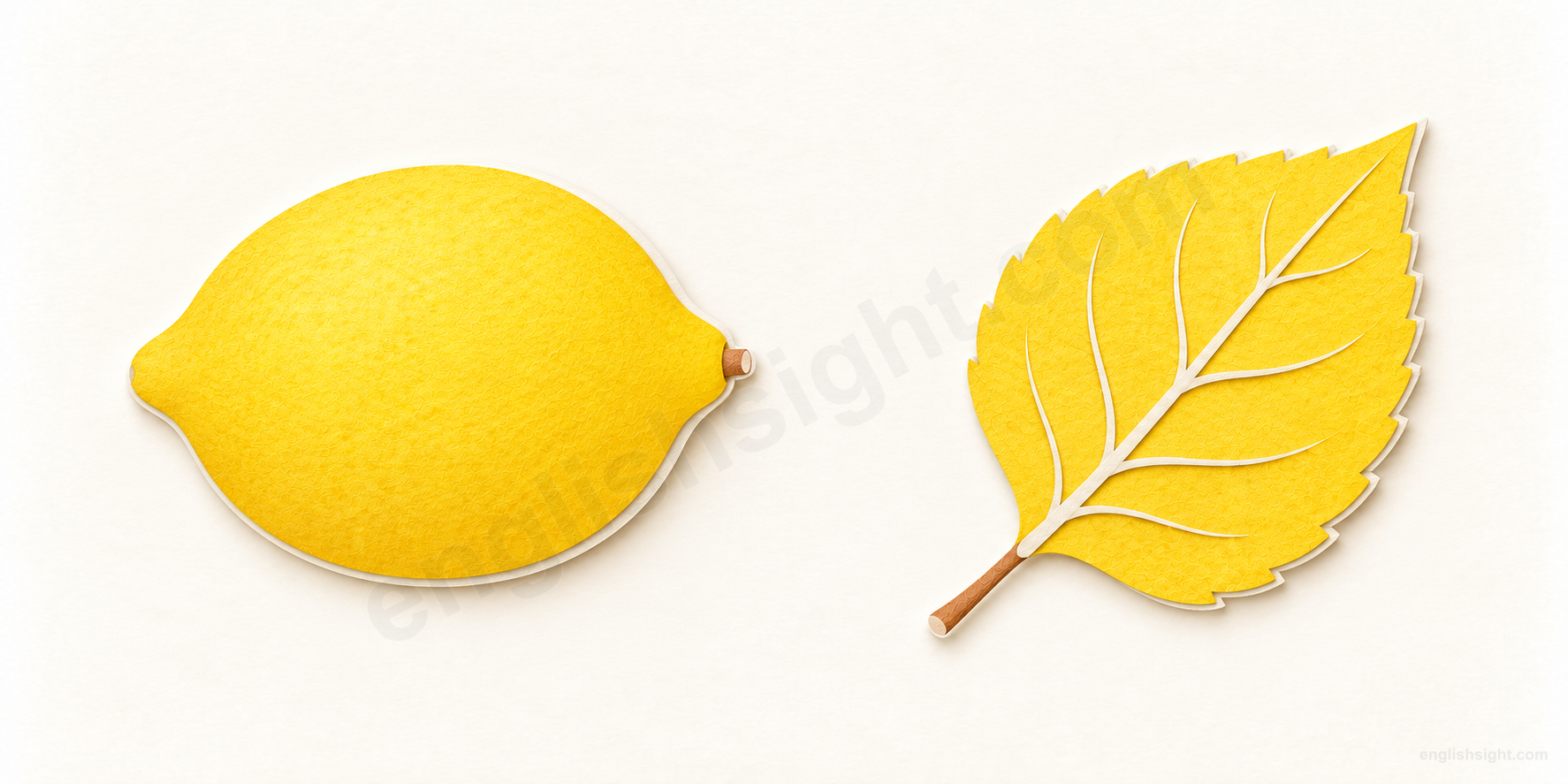
A ripe lemon has a yellow surface.
yellow
An autumn leaf shares the yellow colour.
Compare the colour of the two different objects.
Different objects, the same colour: compare the lemon and leaf side by side.
Yellow identifies a hue like that of a ripe lemon; objects with different shapes and functions can share it.
The sketch compares a ripe lemon with a yellow autumn leaf. Its matching highlight strokes mark the surfaces being compared, not an accurate colour sample. Fixed expressions need separate explanations.
A ripe lemon and an autumn leaf can share a colour without sharing a shape, a use, or a history. Yellow can name that quality, name the colour itself, or describe acquiring it.
Warning signals, criticism of reporting, and the insult meaning cowardly need their own contexts. The visual comparison is a teaching aid, not a picture that every English speaker must imagine.
01
Recognize and describe a colour
Yellow names a visible quality shared by things with very different shapes. Use an adjective to describe an object, or a noun to discuss the colour itself.
01
yellow + noun; subject + be + yellow; the yellow one
a yellow bag / the bag is yellow
describe the colour of an object
Situation / starting point
Several bags are available.
Meaning / result
You identify one by its colour.
Yellow describes a property of the bag, not its shape or purpose.
Use yellow before a noun or after be: a yellow bag; the bag is yellow. It identifies a hue familiar from a ripe lemon. A bag need not resemble a lemon in any other way.
The adjective stays the same with plural nouns: yellow bags, not yellows bags. In the yellow one, one replaces an already understood countable noun.
In a sentence
Please put the yellow bag beside the door.
Watch the difference Say The bag is yellow, with is; yellow is an adjective here, not the sentence’s verb.
02
pale / bright + yellow; yellowish; yellower than; the yellowest
pale yellow / bright yellow / yellowish
describe a shade or an approximate colour
Situation / starting point
You compare colour samples.
Meaning / result
You give a more precise description.
Hue, lightness, and intensity are different details.
Pale yellow describes a light, gentle shade; bright yellow describes a strong, noticeable yellow. These modifiers refine the colour rather than create separate meanings of yellow.
Yellowish means somewhat yellow or having a yellow tinge. It is useful when the colour is not a clear, strong yellow. Yellower and yellowest compare how yellow things appear; they do not necessarily mean brighter.
Lemon yellow names a particular yellow by comparison with a familiar object. Colour labels help choose paint or clothing, but they are not exact measurements.
In a sentence
This sample is yellower than the one beside it.
Watch the difference More yellow is also possible. Do not use more yellower, or assume yellowish means very bright yellow.
03
yellow as a noun; a + shade description + yellow; plural yellows
yellow / a warm yellow / yellows
talk about the colour or its shades
Situation / starting point
You discuss a room’s colour scheme.
Meaning / result
You name the colour rather than a yellow object.
The colour name can be uncountable or refer to a particular shade.
In Yellow would suit this room, yellow is a noun naming the colour generally. A warm yellow refers to one shade, while several yellows refers to different shades.
In a yellow, context matters: an artist may mean a shade or pigment, while another speaker may be shortening a previously named object. The article does not automatically turn yellow into a different colour.
Some dictionaries also record the yellow of an egg for its central part. Yolk is the more specific everyday word to learn for that part of an egg.
In a sentence
We chose a warm yellow for the kitchen.
Watch the difference Do not use an article for the colour in general: Yellow is my favourite colour, rather than A yellow is my favourite colour.
04
wear + yellow; be dressed in + yellow
wear yellow / be dressed in yellow
describe clothing by its colour
Situation / starting point
You need to spot a friend in a crowd.
Meaning / result
You describe what the friend is wearing.
Yellow can stand for the colour of clothing without naming each garment.
She is wearing yellow describes the colour of her clothes. She is dressed in yellow gives a similar description, using in before the colour noun.
She is wearing a yellow jacket names a specific garment instead. These expressions do not mean that her body or skin is yellow.
In a sentence
Look for the woman dressed in yellow near the entrance.
Watch the difference Use in after dressed: dressed in yellow, not dressed yellow. Wear yellow needs no in.
02
Have a colour, acquire it, or give it
The adjective names a state. Turn, paint, and the verb yellow supply different kinds of change; yellow alone does not mean every yellow object has aged.
05
paint / dye + object + yellow
paint something yellow
cause an object to have a yellow surface
Situation / starting point
The shelf has a different colour.
Meaning / result
After painting, its surface is yellow.
The object receives the action; yellow specifies the resulting colour.
In paint the shelf yellow, paint names the action, the shelf is its object, and yellow describes the intended result. Yellow paint instead names the material used.
The same result pattern works with dye: dye the fabric yellow. These are verb–object–adjective constructions, not phrasal verbs. Yellow does not supply the method of changing the colour.
In a sentence
We painted the shelf yellow to match the chairs.
Watch the difference Painted the shelf with yellow paint names the material; painted the shelf yellow names the result. The result adjective takes no article. A shade noun phrase is also possible: painted the shelf a pale yellow.
06
subject + turn / go + yellow
turn yellow / go yellow
become yellow rather than merely have that colour
Situation / starting point
The leaves are not yet yellow.
Meaning / result
Their colour changes.
Turn supplies the change; yellow supplies the resulting state.
The leaves are yellow describes their state now. The leaves turn yellow describes a change. Go yellow can also describe a change, as when paper changes colour.
The cause comes from the situation or added words: yellow is not itself a diagnosis or a statement that an object is old. A freshly painted wall can also be yellow.
In a sentence
The leaves on this tree turn yellow in autumn.
Watch the difference Turn yellow does not require an object. In The leaves turn yellow, yellow is the result adjective and follows turn directly; no to is needed.
07
something yellows; something yellows an object; be yellowed by / with…
paper yellows / yellowed pages
become yellow, or make something yellow
Situation / starting point
The paper originally looks white.
Meaning / result
With time its colour changes.
Yellow can itself be a verb of colour change.
Paper yellows describes a process; paper is yellow describes a state. The verb is regular: yellow, yellows, yellowed, yellowing. Yellowing pages suggests the process, while yellowed pages emphasizes a changed condition.
The verb can also take an object: Smoke yellowed the curtains. The curtains were yellowed by smoke presents the affected curtains first. The change is still in colour; it is not about anyone being afraid.
With age adds a cause or circumstance in yellowed with age. It is not a particle creating a separate phrasal verb. For a deliberate decorating task, paint it yellow or dye it yellow usually gives clearer practical information.
In a sentence
The pages had yellowed during years of storage.
Watch the difference Yellowed is the past form; yellowing is the -ing form. Do not use is yellow as if it alone described an ongoing change.
03
Learn the signal with its setting
A yellow card, light, or road marking has a conventional function. The colour helps identify the signal; its meaning comes from the particular system.
08
get a yellow card; show someone a yellow card; be yellow-carded
get / be shown a yellow card
receive an official caution in sport
Situation / starting point
A football player commits an offence.
Meaning / result
The referee formally cautions the player.
The card’s warning function belongs to the sporting convention.
In football, a yellow card is an official caution. A player can get a yellow card, and a referee can show a player a yellow card. The expression refers to the caution as well as the physical card.
Sports reports may say a player was yellow-carded. This compound verb means officially cautioned; it does not mean painted yellow. The consequences belong to the sport’s rules, so do not transfer one sport’s procedure to every sport.
In a sentence
The referee showed the defender a yellow card.
Watch the difference A yellow card is not the same as immediate dismissal in football; do not replace it with red card when you mean a caution.
09
a yellow light; the light turns yellow
a yellow light
identify the traffic signal before red
Situation / starting point
The signal has been green.
Meaning / result
It changes to yellow before red.
A yellow traffic light is a signal in a traffic system, not a special sense shared by all yellow objects.
Yellow light is especially familiar in American traffic vocabulary. In British English the corresponding signal is commonly called amber. In a room, a yellow light may simply mean illumination of that colour.
The traffic meaning comes from the whole setting. The sentence below reports what the signal did; it does not set out local driving rules.
In a sentence
The light turned yellow as we approached the crossing.
Watch the difference Do not interpret every yellow light as a traffic signal: a lamp can give off yellow light too.
10
a yellow line; single / double yellow lines
single / double yellow lines
recognize a British road-marking term
Situation / starting point
You notice markings along a road edge.
Meaning / result
You recognize that parking is restricted there.
The place and system give the coloured lines their function.
In British road vocabulary, yellow lines at the edge of a road mark parking restrictions. Single yellow lines and double yellow lines distinguish different restrictions.
The words identify the marking; exact conditions come from the local signs and rules. A yellow line in a painting or on a classroom floor has no automatic parking meaning.
In a sentence
There were double yellow lines along that side of the street.
Watch the difference Do not assume that yellow road markings have the same function in every country.
04
Recognize established expressions
Some combinations have meanings that you cannot calculate from a colour sample. Learn their wording, tone, and context together.
11
be yellow; have a yellow streak
be yellow / have a yellow streak
recognize an insulting description of cowardice
Situation / starting point
A character avoids a frightening challenge.
Meaning / result
Another character calls that person a coward.
This is an established negative judgment, not a description of colour.
Calling someone yellow can mean cowardly. It is informal and disapproving, and can sound like a taunt. It does not neutrally describe an ordinary moment of fear.
Have a yellow streak means have a tendency toward cowardice. Streak refers figuratively to a trait in someone’s character, not a visible stripe. A literal yellow streak in someone’s hair is a coloured strip instead.
For a respectful report about feelings, scared or afraid is usually more suitable. Learn this figurative branch for recognition rather than deriving it from the diagram.
In a sentence
In the film, the bully says his rival has a yellow streak.
Watch the difference He is afraid reports a feeling; He is yellow criticizes his courage. They do not carry the same tone.
12
yellow journalism; the yellow press
yellow journalism / the yellow press
criticize sensational reporting
Situation / starting point
A news story uses dramatic claims.
Meaning / result
A critic objects to its exaggerated treatment.
The expression judges the style of reporting, not the colour of the page.
Yellow journalism is reporting criticized for exaggerating or distorting events to shock and attract readers. It is an uncountable expression, especially associated with American English.
The yellow press refers to newspapers that practise this style. Neither expression means news printed on yellow paper, and the phrase does not mean that every entertaining story is dishonest.
In a sentence
The editor rejected the exaggerated headline as yellow journalism.
Watch the difference Say an example of yellow journalism, not a yellow journalism. Learn the full expression; yellow does not freely mean sensational before any noun.
13
look in / look up a business in the Yellow Pages
the Yellow Pages / the yellow pages
recognize a business-directory name
Situation / starting point
Someone wants a local business number.
Meaning / result
They consult a directory arranged by business type.
The established directory name is more specific than pages with a yellow colour.
Traditionally, people used the Yellow Pages to find businesses and their telephone numbers, listed by type of service. In British use it is a name; North American dictionaries also use lower-case yellow pages.
You may meet it in older stories or references to business listings. A book with yellow pages is not necessarily this directory. The UK printed edition is historical; do not assume the printed service is still available everywhere.
In a sentence
In the old story, she finds a plumber in the Yellow Pages.
Watch the difference In this directory name Pages is plural. Do not replace it with a yellow page when you mean the directory.
Keep the colour, grammar, and convention distinct
A colour is not a cause
Yellow describes appearance. Turn yellow and the verb yellow describe colour change; an added cause explains why. Do not infer age, illness, happiness, or danger from the word alone.
Use people’s names and identities respectfully
Yellow has also been used as an offensive racial label for people of East Asian origin. Do not use it to name an ethnicity or a group of people. That use is distinct from a literal description of a yellow garment.
Literal colour versus another language’s conventions
English yellow does not generally mean sexually explicit. Yellow journalism concerns sensational news; it is not a neutral English label for pornography.
Scope and form
This lesson covers the everyday colour, adjective and noun patterns, the colour-change verb, and selected established expressions. It is not a frequency ranking or a list of every compound. Specialist plant and animal names, diseases, pigments, and historical uses need their own contexts.
Choose the meaning that fits
Use the grammar and situation, not just the colour word.
1. The leaves were green; now their colour is changing. Which sentence explicitly describes the change?
2. You applied paint so that a shelf now has a yellow surface. Which sentence expresses that result naturally?
3. A character says, “He has a yellow streak,” while criticizing another character’s courage. What does the character mean?
4. A reviewer criticizes an exaggerated news story as yellow journalism. What is being criticized?
5. A decorator says, “We tried three yellows.” What does yellows most naturally mean here?
Sources and teaching notes
Definitions and usage were checked against the sources below. Explanations, example sentences, and the diagram were written for this lesson; the visual connection is a teaching interpretation.
This diagram helps explain a connection; it is not a picture shared by every native speaker.