Confirm, accept, acknowledge, or react: let the conversation tell you what yes does.
From a question or proposal to a positive response
A speaker puts something forward; another responds positively.
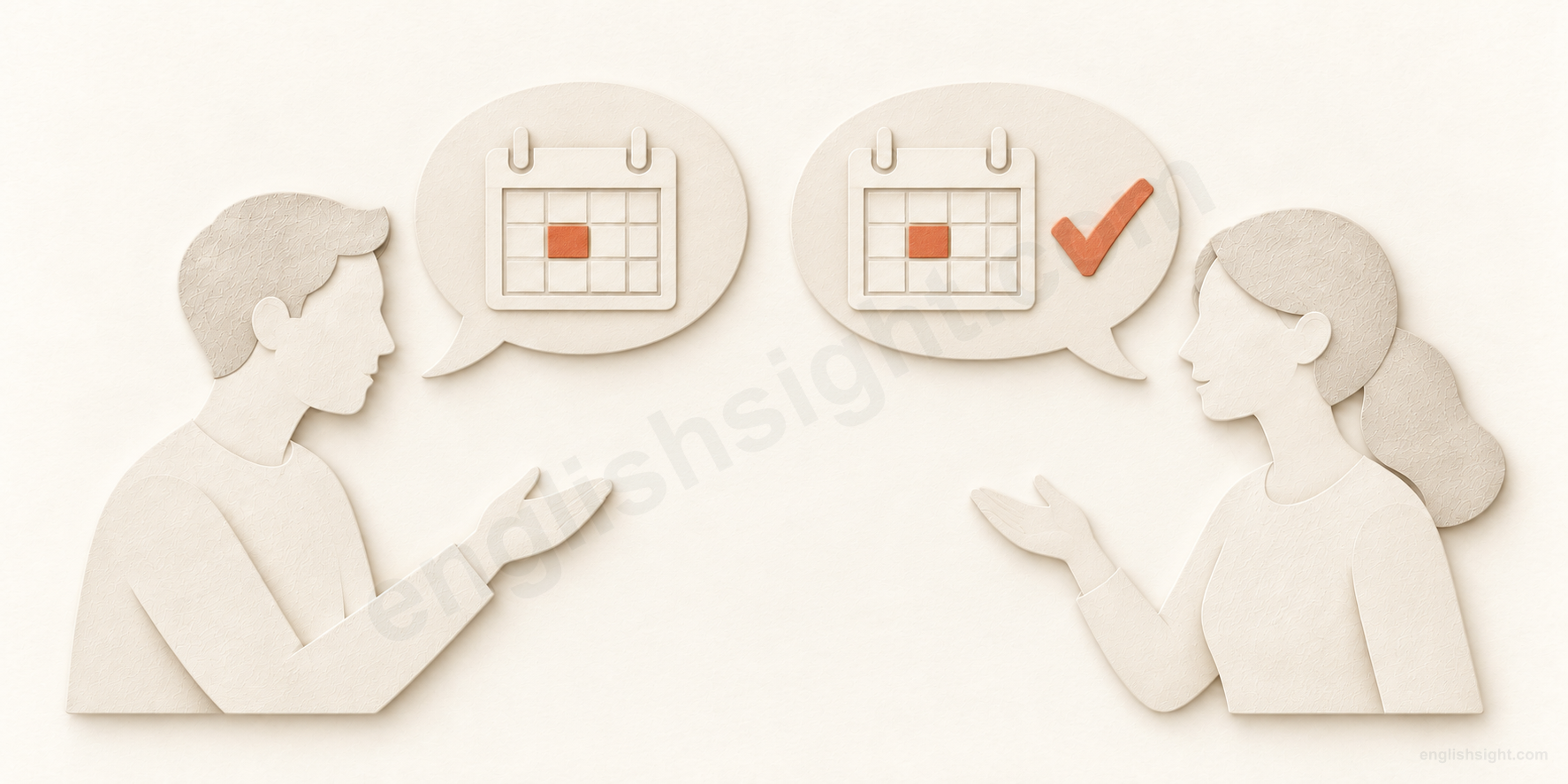
One speaker puts forward a marked calendar date.
yes
The repeated date and check mark represent confirmation, not a completed event.
The other speaker responds positively to that same date.
The date is put forward, then confirmed. The check marks the affirmative reply.
In a basic use, yes presents a response as affirmative: the statement is true, the offer is welcome, or the proposed action is accepted or allowed.
The sketch illustrates confirmation of a proposed date. It is not proof that the meeting has happened. Listening responses and skeptical Oh yes? need the conversational explanations below.
Yes /jes/ is a small word with several conversational jobs. Often it gives a positive response to a fact, offer, or request; elsewhere it shows attention, recalls a thought, or expresses emotion.
The central teaching connection is responding positively to what is in play. It helps connect the basic uses, but tone and established expressions can introduce reservations, impatience, or doubt. This is a learning model, not a shared mental picture claimed for every English speaker.
01
Confirm a fact or correct a negative
Begin with the content being answered. A fuller reply makes clear what is true, especially when the question contains not.
01
Yes; Yes, that’s right / exactly.
Yes, that’s right.
confirm that something is true
Conversation so far
A colleague checks which room you booked.
What the response does
You confirm the room number.
Yes responds positively to the fact under discussion.
“Is our room on the second floor?” asks whether a particular fact is true. Yes confirms it. “The room is on the second floor, isn’t it?” can receive the same confirmation.
Yes, that’s right explicitly confirms someone’s statement or guess. Yes, exactly adds the idea that it matches precisely. Neither expression means that every other detail in the conversation has been accepted.
In a conversation
“Our room is 204, isn’t it?” “Yes, that’s right.”
Watch the difference Identify the fact you are confirming; yes is not a general promise to do whatever follows.
02
Yes + subject pronoun + be / auxiliary / modal
Yes, I do / am / can.
give a clear positive short answer
Conversation so far
Someone asks about your habits, state, or ability.
What the response does
Your reply repeats the relevant helping verb.
The verb after yes tells the listener what is being affirmed.
Use a pronoun and the appropriate form of be, an auxiliary, or a modal: “Do you cook?” “Yes, I do.” “Are you ready?” “Yes, I am.” “Can you drive?” “Yes, I can.” Change the person to match the answer, not mechanically to copy the question.
Other questions give Yes, she did; Yes, we have; or Yes, they will. Use the full positive form at the end of these short replies: Yes, I am, rather than Yes, I’m. A bare Yes is grammatical too; a fuller answer often sounds more engaged and prevents uncertainty about the meaning.
In a conversation
“Did you lock the door?” “Yes, I did.”
Watch the difference Do not use do for every question: “Are you tired?” takes “Yes, I am,” not “Yes, I do.”
Yes can contradict a negative expectation rather than agree with it.
In an ordinary reply to “Don’t you like rice?”, Yes, I do means I like rice. No, I don’t means I do not like it. Follow yes or no with the positive or negative clause so the listener does not have to guess.
The same contrast appears after a negative statement: “The shop isn’t open.” “Yes, it is.” The second speaker rejects isn’t open and asserts is open. Stress can make the correction firm or argumentative; it is not a special new meaning of is.
In a conversation
“Haven’t you finished?” “Yes, I have. I finished an hour ago.”
Watch the difference Do not use yes merely to mean “your negative wording is correct.” State the actual fact when a bare answer could be unclear.
02
Accept, agree, or give permission
A positive reply can accept an offer, undertake a task, or allow someone else to act. The preceding question tells you which.
04
offer → Yes, please / thanks.
Yes, please.
accept something offered
Conversation so far
A host offers you some soup.
What the response does
You accept the offer politely.
Yes accepts the offer; please makes the acceptance courteous.
Use Yes, please when someone offers something you want: “Would you like some soup?” “Yes, please.” You may instead say Yes, thanks. To refuse, No, thank you is a useful counterpart.
For an invitation, a fuller acceptance can be warmer: “Would you like to join us for dinner?” “Yes, I’d love to.” The following words express enthusiasm. Please suits an offered item particularly well; it is not a required ending for every positive reply.
In a conversation
“Would you like a window seat?” “Yes, please.”
Watch the difference A bare Yes may be perfectly clear, but adding please or thanks often suits an offer better.
05
request → Yes, of course / you can / I will.
Yes, of course. / Yes, I will.
allow an action or agree to perform it
Conversation so far
Someone asks to use your charger, or asks you for help.
What the response does
You grant permission or agree to help.
The question decides who will do the action.
After “May I use your charger?”, Yes, of course gives permission to the questioner. After “Will you bring the charger?”, Yes, I will commits the responder to bringing it. Yes itself does not specify the actor.
A limit may follow: Yes, but bring it back before lunch. Permission or agreement is a response to the request; it does not prove that the later action has already happened. Of course can sound warm, while an impatient tone can make it sound obvious or annoyed.
Be careful with “Do you mind if I open the window?” Mind asks about an objection. To give permission clearly, say “No, go ahead” or “I don’t mind.” A literal “Yes, I do mind” objects. In real conversation people may respond to the practical request instead, so avoid relying on a bare yes or no.
In a conversation
“Can I open the window?” “Yes, of course.”
Watch the difference Check who is to act in “Can I…?” versus “Can you…?” With “Do you mind…?”, state permission or objection clearly instead of mechanically saying yes to every request.
06
say yes (to + noun / -ing phrase)
say yes to something
accept a proposal or invitation
Conversation so far
You receive an invitation to join a course.
What the response does
You decide to accept it.
Say reports the response; to introduces what is accepted.
She said yes to the invitation reports her acceptance. The response can be literal speech or a way of describing the decision. Context supplies what was proposed, including a date, a job, or a marriage proposal.
Say yes to a plan uses to as a preposition. An activity can therefore follow as an -ing phrase: They said yes to sharing the cost. Compare They agreed to share the cost, where to begins an infinitive. These patterns belong to different verbs.
In a conversation
We said yes to joining the weekend class.
Watch the difference Say yes to the invitation, not say yes the invitation. This is a verb plus a response and prepositional complement, not a particle verb.
03
Manage the conversation
Yes can acknowledge attention, invite more speech, introduce a reservation, or express doubt. Tone and the following words matter.
07
name / call for attention → Yes?
Yes? Can I help you?
respond when someone wants your attention
Conversation so far
Someone calls your name at reception.
What the response does
You show that you are ready to hear them.
Here yes acknowledges contact rather than confirms a fact.
When someone says “Nina?”, Nina may reply Yes? The reply means that she has heard the call and is ready for the next words. A receptionist can say Yes? Can I help you? when a visitor approaches.
Yes, sir or Yes, madam can acknowledge someone in a formal service setting. The form of address supplies the social relationship. A sharp Yes? can sound impatient, so tone matters when there is no other wording to soften it.
In a conversation
“Nina?” “Yes? What do you need?”
Watch the difference There may be no question about a fact to answer. Do not force “that is true” into this use.
08
speaker pauses → Yes… / Yes?
Yes… / Yes?
show attention or invite more detail
Conversation so far
A friend begins explaining a problem.
What the response does
You encourage the friend to continue.
Listening is different from agreeing with every claim.
A quiet Yes… during a story can show that you are following it. Yes? with an interested tone can invite the next part. The exact sound and surrounding conversation help distinguish these responses from a factual answer.
You can understand a speaker’s point without accepting their conclusion. Later disagreement does not automatically contradict an earlier listening response. This use extends the idea of responding to someone, rather than the idea of approving a particular action.
In a conversation
“There’s one more detail about the booking.” “Yes? Tell me.”
Watch the difference A question mark alone cannot distinguish interest from disbelief; use context and tone.
09
Oh yes? + question / challenge
Oh yes?
question the truth of what someone says
Conversation so far
Someone claims to have a very easy solution.
What the response does
You challenge the claim or ask for evidence.
The familiar positive word can carry a skeptical reaction.
Oh yes? may mean “Is that really so?” rather than “I agree.” A challenging tone and a following question can make the skepticism clear. This is a conventional conversational use; the positive-answer model alone does not predict it.
The same words can express genuine interest in another context. “Oh yes? How did it go?” need not be hostile. Read the whole exchange rather than assigning one fixed emotion to oh or to rising pitch.
In a conversation
“This app can fix every problem.” “Oh yes? How would it fix this one?”
Watch the difference Do not treat every Oh yes? as disbelief or every yes as agreement.
10
Yes, but + clause
Yes, but…
acknowledge a point before adding a reservation
Conversation so far
A friend recommends a cheap hotel.
What the response does
You accept the price advantage but raise a concern.
The yes accepts a point; but limits the conclusion.
Yes, but… often acknowledges something reasonable before presenting a problem or disagreement. The full reply may therefore reject a recommendation even though it begins with yes.
Compare “Yes, and it’s near the station,” which adds supporting information. But signals a contrast or reservation. It does not erase the first point: the hotel may really be cheap even if you do not want to stay there.
In a conversation
“That hotel is cheap.” “Yes, but it’s too far from the station.”
Watch the difference Do not stop listening after yes; the reservation may change the practical decision.
11
Yes and no. + explanation of each side
yes and no
give an answer that differs in different respects
Conversation so far
Someone asks whether your new job is easier.
What the response does
You explain that some parts are easier and others are not.
And combines two perspectives rather than one simple verdict.
Yes and no is a set reply for a mixed answer. It usually invites an explanation of the two sides. It need not mean that you have no opinion or are simply unable to decide.
Compare Yes or no?, which asks someone to choose a definite response. And and or perform different jobs here: a qualified answer versus a request for a choice.
In a conversation
“Is the new job easier?” “Yes and no. The hours are shorter, but the work is harder.”
Watch the difference Do not use yes and no as a precise answer without explaining which respect is positive and which is negative.
12
Oh / Ah yes, + remembered information
Oh yes, …
introduce something just remembered
Conversation so far
You pause while trying to remember what to buy.
What the response does
The missing item comes back to you.
Yes marks recognition of the thought that returns.
Oh yes can mark a return to a forgotten thought or item. Ah yes works in a similar recognition context. No other person needs to have asked a yes-no question.
This is different from the challenging Oh yes? above. Here the following words supply the remembered information. The words oh and ah, the pause, and the context help the listener recognize the function.
In a conversation
What else do we need? Oh yes, batteries for the clock.
Watch the difference Do not explain this as permission or agreement with another speaker when the person is recalling their own thought.
04
Emphasis and emotion
In these uses yes does more than answer a question. It strengthens a statement or expresses a reaction.
13
statement — yes, + repeated / stronger detail
yes, …
reinforce or make a statement more explicit
Conversation so far
You give a surprisingly large number.
What the response does
You repeat it to make sure it is understood.
Yes can strengthen your own statement without answering anyone.
Inserted yes can confirm that surprising wording was intentional: “The repair took six weeks—yes, six weeks.” Repeating the detail gives it emphasis.
It can also introduce a stronger description: “We were pleased—yes, delighted.” The second wording amplifies the first. This is a discourse use, not a claim that yes describes the object as an adjective would.
In a conversation
The wait lasted two hours—yes, two whole hours.
Watch the difference Distinguish emphasis within one speaker’s turn from a separate reply agreeing with another speaker.
14
Yes!
Yes!
express excitement or satisfaction
Conversation so far
Your team scores the winning point.
What the response does
You react with pleasure.
This is a positive emotional reaction rather than a factual short answer.
A forceful Yes! can celebrate success, good news, or a desired result. It does not need an earlier question. The positive orientation remains, but the main purpose is to express pleasure.
Compare a quiet Yes to “Did they win?”, which mainly confirms a fact. Capital letters and exclamation marks can suggest excitement in writing, but voice and situation carry it in speech.
In a conversation
Yes! We finally found the missing key.
Watch the difference Do not use this enthusiastic shout as the model for every ordinary polite answer.
15
Yes, yes, + acknowledgment / intended action
Yes, yes, …
acknowledge something impatiently
Conversation so far
Someone repeats a reminder you have already heard.
What the response does
You signal that you know and want the reminder to stop.
Repetition can express irritation rather than extra enthusiasm.
Yes, yes with an impatient tone can mean “I heard you” or “I know.” The repeated response acknowledges the message while showing annoyance about being told again.
Repetition is not always annoyed: someone may repeat yes excitedly in celebration. The reminder context and following words distinguish this established impatient use from joyful repetition.
In a conversation
“Don’t forget your ticket.” “Yes, yes, I’ve got it.”
Watch the difference This wording can sound dismissive. A calm “Thanks, I’ve got it” is often friendlier.
05
Talk about answers and related expressions
A response can become a countable noun. Learn established compounds as whole expressions rather than inventing meanings from yes alone.
16
a + adjective + yes; plural yeses / yesses; vote yes (to / on a proposal)
a yes / yeses
name an affirmative answer or a person giving one
Conversation so far
A group votes on a proposal.
What the response does
You count the positive responses.
The response becomes something that can be counted.
Yes is a countable noun in “We need a clear yes.” Common modifiers include definite and resounding; a resounding yes is a very strong positive response. The plural is yeses; yesses is also accepted.
In voting or organizing a group, yeses may refer to positive votes or to the people who gave them. “Put me down as a yes” means record me as agreeing or attending in that context. “Vote yes” uses yes as the response to the proposal; “a yes vote” places it before vote.
In a conversation
The proposal received eight yeses and two noes.
Watch the difference A yes is an answer or supporter in context, not an adjective meaning “correct” in an unrelated phrase such as a yes solution.
17
a yes-no question; Yes or no?
a yes-no question
name a question that asks for a positive or negative answer
Conversation so far
You want to know whether a shop is open.
What the response does
You ask about the truth of that possibility.
The compound names a question type, not its answer.
“Is the shop open?” is a yes-no question: yes or no can answer the basic point. “When does the shop open?” asks for a time instead. A real reply may give more information than just one word.
Yes or no? can also press someone for a definite decision: “Are you joining us—yes or no?” That wording can sound demanding. In the compound yes-no question, the two words jointly describe the kind of question.
In a conversation
“Does this bus stop at the museum?” is a yes-no question.
Watch the difference A question offering alternatives such as “Tea or coffee?” normally needs a choice of drink, not just yes.
18
a yes-man; plural yes-men
a yes-man
criticize someone who agrees with a superior too readily
Conversation so far
A manager hears only agreement from an assistant.
What the response does
Someone criticizes the lack of independent judgment.
The compound adds habitual, uncritical agreement and disapproval.
A yes-man agrees with a person in authority instead of giving an independent view, often to please that person. It is a critical label, not neutral praise for being cooperative. The plural is yes-men.
This is an established compound noun. You cannot infer the whole social criticism merely by translating yes and man separately. One polite acceptance does not make somebody a yes-man.
In a conversation
The director wanted honest advice, not a room full of yes-men.
Watch the difference Avoid using yes-man as a neutral name for anyone who votes yes once.
Let the whole reply guide you
A response word, with a noun use too
Oxford labels conversational yes an exclamation, Collins COBUILD a convention, and Merriam-Webster an adverb. These labels describe overlapping response functions; they do not create three separate meanings. The ordinary reply does not take tense endings or an object. In a yes and three yeses it is a countable noun. The uncommon verb yes, yessed, yessing is recorded by Collins but is not developed in this beginner lesson.
Neutral and informal choices
Yes is a neutral spelling. Yeah is a familiar informal alternative, and yep / yup are informal too. For example, “Is the file ready?” can receive “Yeah, it’s ready” in casual conversation. Keep a form suitable for the relationship and setting; informal does not automatically mean rude.
Attention, agreement, and tone
A listening yes does not necessarily accept a proposal, and an interested Yes? does not necessarily doubt it. Oh yes? may be skeptical; Yes, yes may be impatient. Use the surrounding exchange, delivery, and following words instead of assigning a fixed emotion to punctuation.
Negative wording needs a clear clause
After “Don’t you want one?”, Yes, I do says you want one; No, I don’t says you do not. When a bare response might be misread, include the fact or decision in a clause. A polite reply to an offer should also make clear whether you are accepting or declining.
Choose what the response does
Use the question, situation, and following words to interpret yes.
1. You do like rice. A friend asks “Don’t you like rice?” Which reply makes your preference clear?
2. A host offers you some soup, and you want some. Choose the polite acceptance.
3. A friend pauses during a story. You say “Yes? Tell me more.” What are you doing?
4. The journey was quick but uncomfortable. Someone asks “Was it a good trip?” Choose a reply that introduces both sides.
5. Someone asks “Are you ready?” You are ready. Choose the normal positive short reply.
6. “My plan cannot possibly fail.” “Oh yes? How can you be sure?” What does the response express here?
Sources and teaching notes
The sources below support the usage inventory. Explanations, examples, and the compatibility sketch are original teaching material. The visual model is a teaching interpretation, not dictionary evidence.
The diagram is a teaching aid, not a picture shared by every native speaker.