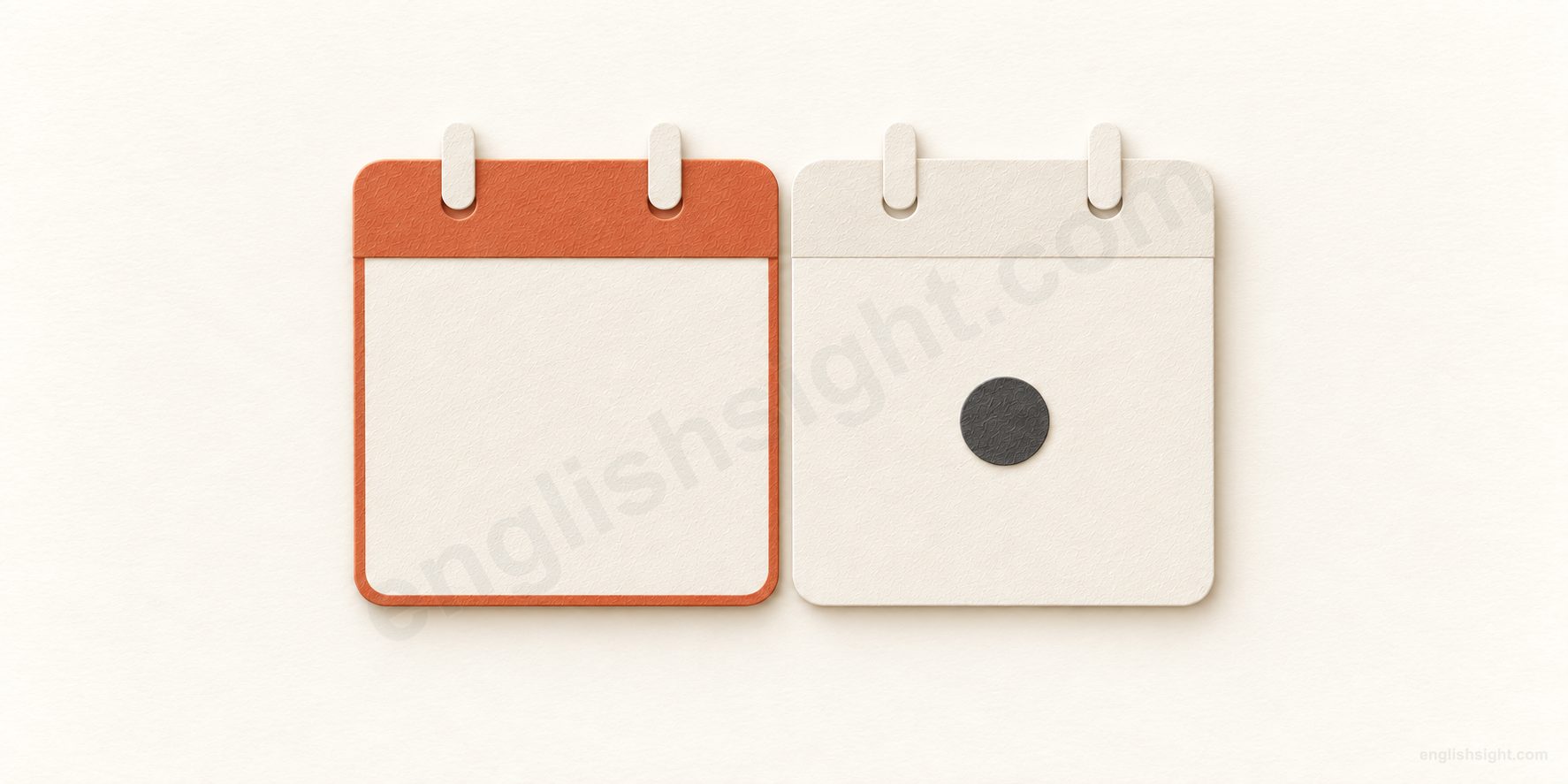
Anchor yesterday to today, then read the whole time expression.
One day back from today
One day back from today
Yesterday: the highlighted day on the left.
yesterday
Today: the day on the right, marked with a dark dot.
Use today as the reference and select the adjacent day before it.
The orange-highlighted day is immediately before the dotted reference day. Yesterday names that calendar day, rather than a moment exactly twenty-four hours ago.
Yesterday locates something in the calendar day immediately before today; as today changes, so does the day yesterday refers to.
The adjacent day panels show a time relationship, not movement of an object. Broader past references and idioms need their own context.
Yesterday usually gives a time in relation to the day of speaking. Once you know which day counts as today, you can identify the preceding calendar day.
The same word can name that day, link something to it, or evoke the past in an expression. The diagram is a teaching aid, not a claim about a picture shared by every English speaker.
01
Locate and describe the preceding day
Start with today as the reference. Name the earlier day, narrow it to a time, or connect a thing to it.
01
past clause + yesterday; yesterday + past clause
yesterday
place an event in the calendar day before today
Situation / starting point
It is Thursday, and you are talking about Wednesday.
Time / intended meaning
Your listener knows which day you mean.
Yesterday identifies a day relative to the time of speaking.
If today is Thursday, yesterday is Wednesday. It means the preceding calendar day, rather than exactly twenty-four hours before this moment. An event at 11 p.m. can be yesterday even when it is now only 1 a.m.
Put the time expression near the end of the clause, or at the beginning to set the scene: Yesterday, I repaired my bike. Do not add on, in, or at directly before yesterday in this ordinary use.
Use the past simple for a completed event located yesterday: I repaired it yesterday. The past continuous can describe an activity in progress: I was repairing it at noon yesterday. Yesterday locates the time; the verb form describes the event.
In a sentence
I repaired my bike yesterday.
Watch the difference For a completed event, say I repaired it yesterday, rather than I have repaired it yesterday.
02
yesterday + morning / afternoon / evening; at + time + yesterday; all day yesterday
yesterday morning / afternoon / evening
identify a part of the preceding day
Situation / starting point
You want to say more precisely when a call happened.
Time / intended meaning
The listener places it in the afternoon of the day before today.
A day part narrows the day; it does not change the reference day.
Yesterday morning, yesterday afternoon, and yesterday evening name parts of the day before today. Say yesterday afternoon without in: We spoke yesterday afternoon. For the preceding night, last night is the usual everyday choice.
You can be more precise: at three yesterday afternoon or yesterday afternoon at three. Early yesterday morning and late yesterday evening add timing within that part of the day.
All day yesterday describes duration across that day: I studied all day yesterday. Yesterday alone does not say whether an event occupied a moment or many hours.
In a sentence
The clinic called yesterday afternoon at three.
Watch the difference Use last night as the ordinary expression for the previous night; avoid making yesterday night your default.
03
yesterday + was + description; comparative + than yesterday
Yesterday was…
talk about the preceding day itself
Situation / starting point
You are comparing how two days went.
Time / intended meaning
You describe yesterday as a whole.
Yesterday can name a day as a noun, rather than simply tell when an action occurred.
In Yesterday was quiet, yesterday is the subject of was. In I arrived yesterday, it tells when you arrived. You do not need the yesterday to name the preceding day.
It can also be the reference point in a comparison: Today is warmer than yesterday. The comparison is with the weather on that day, not with an object called yesterday.
In a sentence
Yesterday was quiet, but today has been busy.
Watch the difference Use Yesterday was busy without an article; the ordinary day reference is not a yesterday or the yesterday.
04
yesterday’s + noun; yesterday’s with an understood noun
yesterday’s meeting
associate something with the preceding day
Situation / starting point
You have notes from meetings on different days.
Time / intended meaning
You identify the notes linked to the meeting one day ago.
The possessive marks a time association; the day does not literally own anything.
Yesterday’s meeting means the meeting that took place yesterday. The same pattern works with yesterday’s results, yesterday’s weather, or yesterday’s lunch. The following noun tells you what kind of connection to the day is intended.
If the noun is already understood, leave it out: Is this today’s schedule? No, it’s yesterday’s. Keep the apostrophe and s in both forms.
A message from yesterday also identifies a message by its date. In a literal phrase such as yesterday’s news, the news may simply be from that day; an idiomatic reading is explained later.
In a sentence
I saved the notes from yesterday’s meeting.
Watch the difference Write yesterday’s meeting with an apostrophe; yesterdays is a different, literary plural form.
05
the day before yesterday; two days ago
the day before yesterday
identify the day two calendar days before today
Situation / starting point
Today is Thursday, and an event happened on Tuesday.
Time / intended meaning
You locate it two days back.
Before adds one more day before yesterday.
If today is Thursday, the day before yesterday is Tuesday. Two days ago is another ordinary way to locate that day. The other day only means some recent day; it does not fix the same two-day interval.
Keep the reference point clear when retelling a past conversation. If someone spoke on Thursday about Wednesday and you report it on Saturday, the day before or the previous day can preserve Wednesday relative to Thursday. Yesterday spoken on Saturday would normally mean Friday. Use the date when clarity matters.
In a sentence
We visited the museum the day before yesterday.
Watch the difference Use the full expression the day before yesterday; before yesterday alone means earlier than yesterday and need not mean exactly two days ago.
02
Connect yesterday to other times
Since, by, and until add a start, deadline, or endpoint. These relationships come from the complete construction.
06
present perfect + since yesterday; from yesterday to today
since yesterday
give yesterday as the start of a period reaching now
Situation / starting point
The internet stopped working during the preceding day.
Time / intended meaning
It still does not work now.
Since supplies the starting-point relation; yesterday supplies the day.
Since yesterday connects a starting time in the preceding day to a later reference time. In The internet has been down since yesterday, that later time is now, so the outage continues.
Compare It stopped working yesterday, which dates the failure without saying how long it continued. A completed event yesterday normally takes a past tense; a state continuing from yesterday to now can take the present perfect.
From yesterday to today can name both ends of an interval: This log covers the period from yesterday to today. Do not use for yesterday to mean a period continuing from that day; for a day expresses a duration instead.
In a sentence
The internet has been down since yesterday.
Watch the difference Since yesterday and yesterday have different time relationships; the present-perfect restriction on bare yesterday does not ban since yesterday.
07
by + time / yesterday; continuing situation + until yesterday
by yesterday / until yesterday
distinguish a deadline from the endpoint of a continuing situation
Situation / starting point
You are checking when work had to be finished or how long a service lasted.
Time / intended meaning
You identify either a latest completion time or an endpoint.
The preposition changes the time relationship, while yesterday keeps its day reference.
By yesterday gives a latest time in the past: The forms had to be ready by yesterday. They could have been ready earlier. If an exact cutoff matters, say by noon yesterday or by the end of yesterday.
Until yesterday describes continuation up to a point in that day: The old website worked until yesterday. It does not mean the website had to become ready by then. Neither phrase alone supplies an exact clock time.
Compare I finished it yesterday, which locates completion within the day, with I had finished it by noon yesterday, which locates completion no later than that cutoff.
In a sentence
The forms had to be ready by noon yesterday.
Watch the difference Use by for a deadline and until for continuation up to an endpoint; they are not interchangeable.
03
Talk about the past and felt recency
In comparisons and reflective writing, yesterday can evoke past life or make an old memory feel close.
08
noun + of yesterday; rhetorical yesterday…today contrast; literary plural yesterdays
the world of yesterday / yesterday…today
refer more broadly to a past period
Situation / starting point
You compare older ways of living with life now.
Time / intended meaning
Yesterday evokes an earlier world rather than a single date.
A contrast with today can expand the reference from one day to the past.
In the world of yesterday, yesterday can mean an earlier period. Context tells you that the writer is comparing eras or ways of life, not describing only the preceding calendar day. This use often sounds reflective or rhetorical.
Yesterday can also be a time adverb in a rhetorical contrast: Yesterday, these jobs were done by hand; today, machines do them. Here the contrast evokes an earlier period. In an ordinary event report, yesterday still normally means the preceding calendar day.
You may encounter the plural yesterdays in poetry or reflective writing: She wrote about the yesterdays of her childhood. It treats past days or experiences as separate remembered parts of life. In ordinary date reports, say yesterday; do not use yesterdays to mean the single day before today.
In a sentence
The exhibition compares the kitchens of yesterday with those of today.
Watch the difference A broad past meaning does not make yesterday a free substitute for last year or any specific historical date.
09
it seems / feels like (only) yesterday + (that) clause; remember + as if it were yesterday
It seems like only yesterday…
say that an older experience feels very recent
Situation / starting point
You remember your first class, although it happened years ago.
Time / intended meaning
You convey the impression that very little time has passed.
The comparison describes felt recency, not the actual date.
It seems like only yesterday that we started school can be said many years later. Like makes a comparison, and seems presents an impression. Yesterday supplies the idea of a very recent day.
I remember it as if it were yesterday emphasizes how clear or immediate the memory feels. These comparisons do not change the actual date. In I only found out yesterday, however, yesterday can be literal: the discovery really was one day ago.
In a sentence
It seems like only yesterday that we moved here, but it was ten years ago.
Watch the difference Do not interpret an explicit comparison about a ten-year-old memory as a claim that it happened one day ago.
04
Recognize established expressions
Learn the full expression and its tone: resisting deception, dismissing an old trend, or expressing urgency.
10
subject + was / were not born yesterday
I wasn’t born yesterday.
reject the idea that you are easy to fool
Situation / starting point
Someone offers an explanation you find suspicious.
Time / intended meaning
You insist that you have enough experience to recognize a trick.
The whole idiom conveys experience, rather than giving a birth date.
I wasn’t born yesterday is a familiar way to say that you are not naive. The point is that you have lived long enough to know how things work; it is not normally an answer to When were you born?
The expression can sound defensive or confrontational. It fits a warning against treating you as foolish, but may be too sharp for a neutral request for more information. The negative form is central to this idiom.
In a sentence
You say this phone is brand new, but the screen is scratched. I wasn’t born yesterday.
Watch the difference Do not use the idiom merely to say you are older than one day; its usual purpose is to resist being deceived.
11
someone / something + be + yesterday’s news
yesterday’s news
describe something or someone whose popularity has passed
Situation / starting point
A once-fashionable app has lost its audience.
Time / intended meaning
You dismiss it as belonging to a former trend.
The idiom evaluates present relevance; it does not give a publication date.
Calling something yesterday’s news can mean that it was once popular but is no longer fashionable or important to people now. It can apply to an app, a trend, or a public figure, even though none is literally a news report.
Compare I read yesterday’s news on the train, where the phrase can simply mean news from the preceding day. Context decides whether it dates news or dismisses something as out of date. Applied to a person, the idiom can sound unkind.
In a sentence
That app was everywhere last year, but now it’s yesterday’s news.
Watch the difference Keep the apostrophe in yesterday’s; the expression is not yesterdays news.
A task is still unfinished, and you want it immediately.
Time / intended meaning
You express impatience by imagining a deadline already past.
This informal use is deliberate exaggeration, not an ordinary date statement.
In I need the figures yesterday, the present need and the past day create an impossible demand. The intended message is that the figures are wanted immediately and already feel overdue. The same pattern occurs with want something done yesterday.
This can sound forceful or impatient. For a clear, polite request, give a real deadline: Could you send the figures by three today? Compare I needed the figures yesterday, which may simply describe a genuine need on that past day.
In a sentence
We still don’t have the figures, and the manager says she needs them yesterday.
Watch the difference This marked exaggeration does not make present-tense date statements such as I arrive yesterday standard.
Keep the reference day and the construction clear
The day of speaking matters
Yesterday normally refers to the day before the speaker’s today. When quoting someone, the quotation keeps that speaker’s original reference. When retelling it later, a date or the previous day may be clearer. Yesterday is not simply any day before another past event.
Tense is not built into the word
For completed events on yesterday’s date, use a past tense in standard English. Since yesterday can describe a period reaching now, and I need it yesterday is a marked informal exaggeration. These do not cancel the ordinary tense pattern.
Word classes and forms
The principal learner-dictionary categories are adverb and noun. Some American dictionaries label yesterday before morning an adjective; the useful expression is the same. The ordinary day reference has no comparative form or verb inflections. Literary yesterdays differs from possessive yesterday’s; passive, causative, and phrasal-verb inventories do not apply to this word.
Regional boundary
British informal yesterday week means a week before yesterday, eight days before today. It is included here for recognition rather than as a general international model; an exact date or eight days ago is clearer across varieties.
Choose the time relationship
Use the situation, the reference day, and the whole expression.
1. Today is Thursday. Which day does the day before yesterday name?
2. You finished a repair on the day before today. Which ordinary sentence gives that finished time?
3. The shop closed yesterday and remains closed now. Which sentence expresses continuation to now?
4. The forms had to be complete no later than noon on the preceding day. Which phrase fits?
5. A seller makes a suspicious claim. You reply, “I wasn’t born yesterday.” What are you communicating?
6. An impatient manager says, “I need those figures yesterday.” What is the intended message?
Sources and teaching notes
The main meanings were checked against Collins and Merriam-Webster, with grammar references below. The supplementary Cambridge urgency entry was available as indexed publisher text; its direct page was blocked. Explanations, examples, and the visual model are original teaching material.
The diagram explains a time relationship; it does not represent a picture shared by every native speaker.