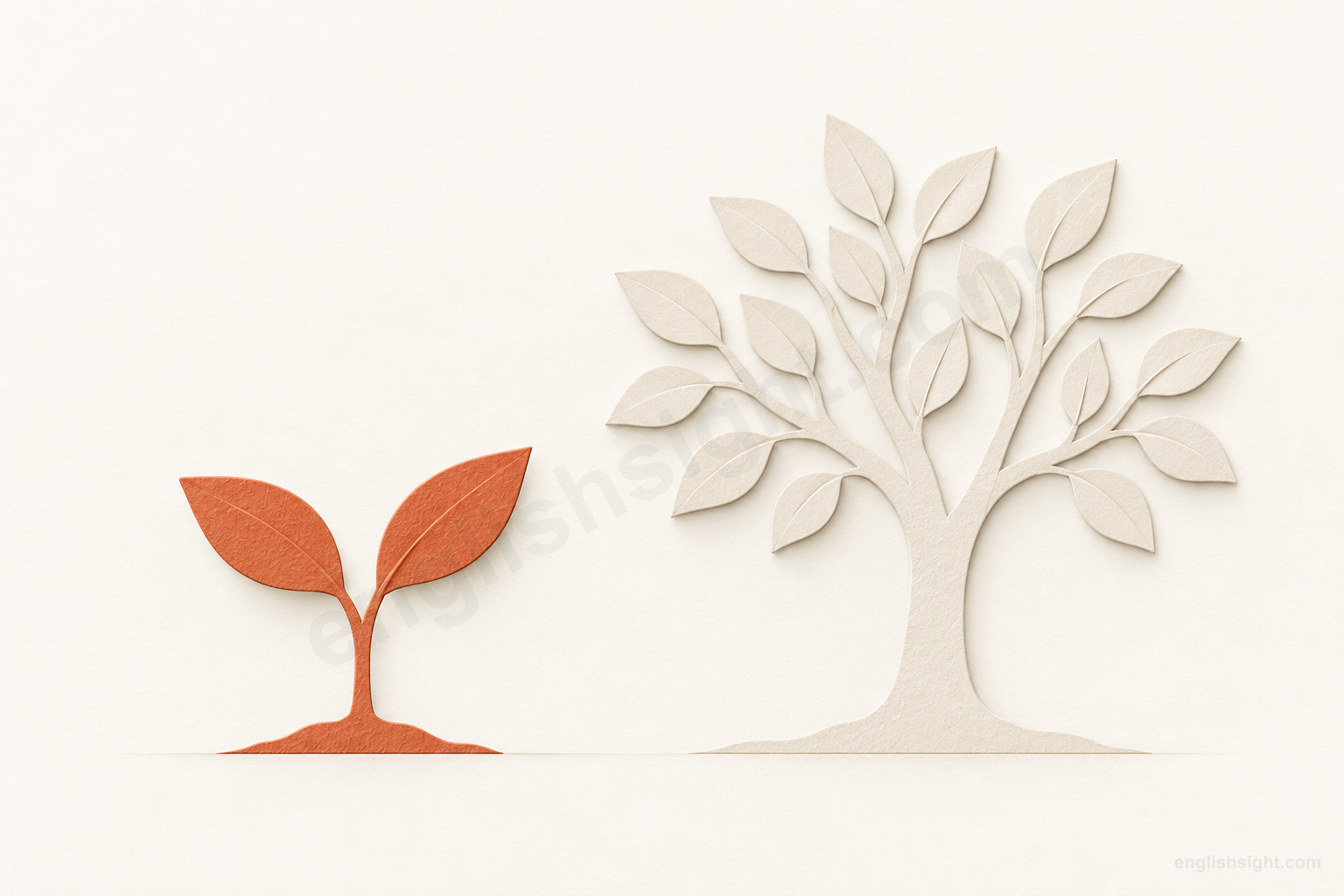
Connect age, relative youth, and youthful qualities without treating them as the same claim.
Early relative to a course of growth
Early relative to a course of growth
Early growth
young
A later stage for comparison
Young marks a relatively early stage of life or development.
The sapling illustrates early growth; the developed tree supplies a later-stage comparison. Size alone does not define young.
Young places something at a relatively early stage of its life or development, compared with later stages or with others.
A sapling makes early growth visible. Young does not simply mean small, newly bought, inexperienced, or childish; context determines which age or youthful quality matters.
Young locates a person, animal, plant, or developing thing relatively near its beginning. What counts as young depends on the lifespan, comparison, or purpose in the conversation.
From there, English also talks about youthful appearance and attitude, groups of young people, and animal offspring. Fixed expressions add meanings and tones that you need to learn with the whole phrase.
The picture is a teaching comparison, not a claim that every English speaker sees the same image when hearing young.
01
Age, comparison, and life stages
Young describes age relative to a lifespan, another person, or a situation. The surrounding grammar supplies the comparison or age requirement.
01
young + noun; be / still be + young
a young person / animal / plant
be early in life or growth
Situation / reference
A tree has only recently begun growing.
Meaning in context
It is described as a young tree.
Young places something early in the relevant lifespan, not on a universal age scale.
Use young before a noun or after be: a young child; the child is young. It can describe people, animals, and growing plants. Very young and still young make the degree or continuing stage explicit.
The age that counts depends on the kind of living thing and the situation. A young adult is an adult, not a child; a young tree need not have the same age in years as a young dog.
The highlighted sapling in the diagram illustrates this early-stage relation. Being physically small is not enough: a small fully grown plant can be old.
In a sentence
The young trees need shelter from strong winds.
Watch the difference Say She is young or She is a young woman. Young does not replace woman in a young.
02
younger than + person; number + years younger; the youngest of / in + group
younger than / the youngest
compare ages within a pair or group
Situation / reference
Two sisters are 42 and 46.
Meaning in context
The 42-year-old is the younger sister.
Younger compares ages; neither person has to count as young overall.
The forms are young, younger, youngest. Use than to introduce the other person: younger than me or, more formally, younger than I am. A difference can come before younger: four years younger.
My younger sister identifies a sister who is younger than I am. The youngest of three sisters identifies the one with the lowest age in that group. My youngest sister needs no extra the after my.
Both sisters could be elderly: relative age and the general description young are different judgments. The formal label the younger can also distinguish relatives with the same name, as in William Pitt the Younger.
In a sentence
Maya is four years younger than her sister.
Watch the difference Use younger than, not younger that, and avoid more younger.
03
too young + to-infinitive / for + noun; young enough + to-infinitive
too young to… / young enough to…
relate age to an action or condition
Situation / reference
A child wants to join a class for older children.
Meaning in context
His age is below the class’s requirement.
Too and enough add an age judgment; young itself names no rule.
Too young to do something says the person’s age prevents, makes unsuitable, or makes unlikely the action in context. Too young for this class uses a noun phrase after for.
Young enough to do something says youth is sufficient for a relevant possibility. She is young enough to be his daughter compares possible ages; it does not identify their actual relationship.
You can be very young without being too young. Too introduces an excess relative to a purpose, not simply a strong degree.
In a sentence
He is too young to join this class.
Watch the difference Say young enough, not enough young. To join supplies the action; young is not a verb taking an object.
04
marry / die + young; at a young age
marry young / die young
say how old someone is when an event happens
Situation / reference
You describe when your grandparents married.
Meaning in context
Their marriage took place early in their adult lives.
Young describes the people at the time of the event.
In marry young, the adjective describes the subject when the marriage happens. It is not a separate verb or an instruction to marry a young person. They married young and They married young partners have different structures.
Die young similarly places death at an early age. At a young age makes the time relation explicit and works with many events: start swimming at a young age.
There is no single age boundary built into these expressions. State the actual age when precision matters.
In a sentence
My grandparents married young and built their first home together.
Watch the difference Do not substitute youngly. In at a young age, keep both a and age.
05
when + subject + was / were young; in + possessive + younger days
when I was young / in my younger days
refer to an earlier period of someone’s life
Situation / reference
You recall learning to sail decades ago.
Meaning in context
You place that activity in your earlier life.
The person is older now; young locates the remembered life stage.
When I was young gives a time clause. In my younger days uses younger to compare an earlier version of me with me now. It need not mean the very youngest period of childhood.
My young days is possible, especially in a more literary or nostalgic voice, but in my younger days is a useful everyday expression to learn. The young Elena can likewise refer to Elena at an earlier age.
In a sentence
In my younger days, I spent every summer sailing.
Watch the difference In my younger days refers to my age then, not to days that contain fewer hours.
02
Appearance, attitude, and groups
Youth can be a matter of appearance, behavior, or the ages of people in a group. These readings need context; they do not all state a birth date.
06
look / feel + young; keep + person + young
look young / feel young / keep someone young
describe youthful appearance or feeling
Situation / reference
A long walk leaves an older person feeling lively.
Meaning in context
The person feels young without becoming younger in years.
Appearance, feeling, and actual age can differ.
Look young describes appearance; feel young describes the person’s own experience. Neither changes the birth date. Look younger than you are compares apparent age with actual age.
Keep someone young means help that person retain youthful energy, interests, or feelings. The object is the person and young is the condition being maintained: Music keeps me young.
Young can suggest energy or lack of maturity depending on context. It is not always praise, and youthful is often a clearer choice when you mean a youthful quality rather than a low age.
In a sentence
Learning new dances keeps my grandfather young.
Watch the difference Use the adjective young after look and feel here, not the noun youth.
07
be / look + young for + possessive + age
young for your age
seem younger than others of the same age
Situation / reference
A teenager behaves less maturely than classmates.
Meaning in context
You compare development with expectations for that age.
For your age sets the age-based comparison; context selects appearance or maturity.
He looks young for his age normally concerns appearance. He is young for his age can concern behavior or development: he seems less mature than people of the same age usually seem.
Do not automatically treat the expression as a compliment. In a discussion of readiness or responsibility, it may express concern about maturity. Add look, emotionally, or another clear description when ambiguity matters.
In a sentence
Ben is young for his age and finds the older pupils intimidating.
Watch the difference Young for his age does not mean his stated age is incorrect.
08
have + a young family; a young + group noun
a young family / audience
describe a group containing young people
Situation / reference
Parents have two small children.
Meaning in context
You describe them as having a young family.
The age description applies to the family’s children or the group’s members.
Have a young family usually means have young children. It does not require both parents to be young or mean the family was only recently formed.
A young audience has a low average age or mainly young members. A young team can concern the players’ ages; context may instead emphasize a recently formed team. Specify newly formed when that is your intended meaning.
In a sentence
They need a flat with more space for their young family.
Watch the difference A new family and a young family are not automatically the same thing.
09
clothing / style + be / look + young; too young for + person
too young for me
describe a style associated with younger people
Situation / reference
You try on a jacket with a very youthful design.
Meaning in context
You judge its style unsuitable for your own taste or age.
The style is associated with youth; the item itself may be brand-new or old.
A dress or hairstyle can be described as young when its style seems intended for younger people. This is a judgment about style, not about how recently the item was made.
This jacket is too young for me expresses the speaker’s own assessment. It is not an objective rule about what someone of that age may wear.
In a sentence
I like the colour, but the style feels too young for me.
Watch the difference A young-looking style is different from a new item that has just been bought.
10
young man / young lady / young woman as direct address
young man / young lady
address a young person, sometimes with a warning tone
Situation / reference
A parent asks a child to explain a broken window.
Meaning in context
The form of address signals seriousness or annoyance.
Tone turns an age label into a way of addressing someone.
A young man in a description can simply mean a male person of a relatively low age. Used directly to someone, young man or young lady can sound stern, especially from an older speaker.
The warning comes from the whole utterance, relationship, and tone, not from a special negative meaning of young. Young woman is also possible as a direct address. These forms can sound patronizing between adults.
In a sentence
Young man, please explain what happened to this window.
Watch the difference A polite description such as a helpful young man does not necessarily carry the stern tone of direct address.
03
An early stage beyond human age
A plant, organization, or period can be young because it is near the beginning of its development or duration. New and young overlap in some contexts, but they are not interchangeable everywhere.
11
a young + company / industry / wine; still + young
a young company / young wine
be relatively early in existence or development
Situation / reference
A business has operated for only two years.
Meaning in context
It is still a young company.
The early-stage relation extends from life to development.
A young company or industry has a short history relative to its field. It may still be developing. This does not necessarily mean its staff are young or that it is unsuccessful.
Young wine has not aged for long; it is not the same as wine you have just bought. Young leaves and young vegetables refer to early growth, often relevant to their texture or use as food.
Young can also suggest limited experience in descriptions of people, such as young and inexperienced. Youth and inexperience often overlap in a context, but age alone does not prove someone lacks skill.
In a sentence
Our company is still young, but it already exports to several countries.
Watch the difference A new employee may be old and experienced; do not replace new with young whenever someone has recently joined.
12
the night / day / season + be + (still) young
The night is still young.
say an evening is early and time remains
Situation / reference
Friends consider going home soon after dinner.
Meaning in context
You suggest there is still time to do something else.
A period is treated as being near its beginning.
The night is still young says that little of the evening or night has passed. In conversation it often encourages people to stay out or continue enjoying themselves.
The season is still young and the day is young use the same early-period extension. They can suggest that there is time for events or results to change; they do not predict that things will improve.
In a sentence
We could hear another band; the night is still young.
Watch the difference Young here describes the stage of a period, not the ages of the people going out.
04
Young people and animal offspring
Young also occurs in noun uses. Learn their grammar separately from an adjective describing one person or animal.
13
the young + plural verb; young and old (alike)
the young / young and old
refer to young people collectively
Situation / reference
A town discusses opportunities for younger residents.
Meaning in context
The young names that age group.
The young is a plural group expression, not one young person.
The young refers to young people considered as a group. Use plural agreement: The young are…, not The young is…. Young people is often a more direct and neutral way to name the people you mean.
Young and old is an established pairing meaning people across the age range. The can be omitted in this pairing: an event for young and old alike.
For one person, say a young person, a young woman, or another appropriate noun. Do not make a regular plural youngs for people.
In a sentence
The festival offers activities for young and old alike.
Watch the difference The young are interested is grammatical; a young is not the ordinary way to say a young person.
14
animal + possessive + young; the young of + animal
feed their young
refer to an animal’s offspring
Situation / reference
Birds bring food back to a nest.
Meaning in context
Their young are the chicks receiving the food.
Young is a plural noun for offspring, with no added -s.
An animal’s young are its offspring. A mother bird feeds her young; the young of a fox are cubs. The possessive identifies the parent, not an owner buying animals.
In this usual collective use, young takes plural agreement: Her young are safe. It is especially used for animals; children is the ordinary choice when talking about someone’s human family.
To name one baby animal clearly, use its species word or a phrase such as a young fox. Some dictionaries record a singular noun young, but it is not the basic conversational pattern taught here.
In a sentence
The swallows return often to feed their young.
Watch the difference Their young are hungry, not their youngs are hungry. Young foxes is different: young is then an adjective before foxes.
15
animal + be + with young
with young
say an animal is pregnant
Situation / reference
A wildlife report describes a female deer before birth.
Meaning in context
With young refers to the unborn offspring.
This fixed phrase differs from being accompanied by offspring.
An animal that is with young is pregnant. The phrase belongs especially to animal description and wildlife writing; pregnant is the clearer ordinary word in many everyday conversations.
Compare a deer with her young: adding her normally describes a deer accompanied by her offspring, rather than asserting pregnancy. The small grammatical difference changes the relation.
In a sentence
The guide said the deer was with young.
Watch the difference Do not use with young as your usual expression for a pregnant person. Do not confuse it with with her young.
05
Established expressions in conversation
These expressions draw on youth, aging, or youthful qualities. Their message and tone belong to the whole phrase, rather than to a literal picture of age.
16
be / stay + young at heart
young at heart
retain a youthful outlook despite age
Situation / reference
An older relative eagerly tries new activities.
Meaning in context
You describe the person as young at heart.
The phrase concerns outlook or spirit, not chronological age.
Young at heart describes youthful enthusiasm, interests, or ways of thinking in someone who is no longer young in years. At heart points to inner character or feeling.
The expression can be affectionate. It does not imply medical heart health or that all older people ought to behave like young people.
In a sentence
At eighty, Rosa is still young at heart and keen to try new things.
Watch the difference Do not read heart literally here: the phrase is about attitude, not the age or health of an organ.
17
subject + be not getting any younger
not getting any younger
acknowledge aging or urge action while there is time
Situation / reference
You have postponed a long-planned journey.
Meaning in context
You mention aging as a reason to stop delaying.
The negative expression acknowledges that time is passing.
I’m not getting any younger usually means I am getting older, often with the implication that I should act now rather than postpone something indefinitely.
We’re not getting any younger can be a shared joke about age. Said to someone who is keeping you waiting, it can express impatience. The urgency comes from context, not from a new literal age calculation.
In a sentence
I’m not getting any younger, so I’ve finally booked the walking holiday.
Watch the difference This does not mean the speaker expected the aging process to reverse.
18
a group of people + be getting younger
They’re getting younger.
comment on a group’s lower age or your changing perception
Situation / reference
New members seem much younger than you remember.
Meaning in context
You comment on their ages or on how they appear to you now.
The group can change even though individual people do not age backward.
The volunteers are getting younger can mean newer volunteers have a lower average age. The individuals are not literally becoming younger.
The phrase can also be an amused comment on your own aging: professionals you once regarded as older now seem surprisingly young to you. Context determines whether it is a demographic claim or a personal impression.
In a sentence
The new doctors seem to be getting younger every year—or perhaps I’m just getting older.
Watch the difference Do not infer that the same doctor has physically lost years of age.
19
you’re only young once
You’re only young once.
encourage someone to enjoy the opportunities of youth
Situation / reference
A young adult hesitates over an enjoyable opportunity.
Meaning in context
A friend encourages taking the opportunity while young.
Only once emphasizes that this life stage will not return.
This saying is used to encourage young people to enjoy themselves or make use of opportunities before later responsibilities. It may also justify the speaker’s own choice.
It gives encouragement, not a factual guarantee that a particular decision is wise. Depending on the situation it can sound playful, supportive, or like an excuse.
In a sentence
“Shall I join the summer theatre tour?” “You’re only young once!”
Watch the difference Only young once is a saying, not a rule that learning or enjoyment must stop later.
20
have + an old head on young shoulders
an old head on young shoulders
describe unusual good sense in a young person
Situation / reference
A teenager handles a difficult decision calmly.
Meaning in context
You praise maturity beyond what you expected at that age.
Old and young contrast wisdom with chronological age.
Have an old head on young shoulders describes a young person who shows notably mature judgment. Head stands for good sense; shoulders locate that wisdom in a young person.
It is an idiomatic compliment, not a description of physical appearance. It also shows why young must not automatically be equated with foolish or irresponsible.
In a sentence
Ella has an old head on young shoulders; she stayed calm and found a fair solution.
Watch the difference The phrase is about sensible behavior, not looking older than you are.
21
bring in / need + (some) young blood
young blood
refer to younger newcomers and the energy or ideas they bring
Situation / reference
An established club wants fresh ideas.
Meaning in context
It brings in younger members.
The fixed metaphor presents newcomers as a source of renewal.
Young blood can refer to young people joining an organization, especially when they are expected to bring new talent, ideas, or energy. It can also emphasize that youthful energy itself.
In this use blood is a metaphor, usually in a mass expression such as some young blood. New blood and fresh blood similarly emphasize renewal, without necessarily making the newcomers’ age the point.
Use a direct description such as new members when you want neutral wording. The metaphor is not about blood donation or biological superiority.
In a sentence
The club brought in some young blood to help plan events for students.
Watch the difference Do not call each newcomer a blood or add -s to blood in this expression.
Age, development, and tone are separate questions
Young is relative; small is about size
A young adult can be fully grown and responsible. A younger person can still be old. Give an age in years when precision matters, and do not infer experience, competence, or character from young alone.
Young, new, and youthful
New often means recently made, acquired, or introduced into a situation. Young concerns age or a stage of development. A new car may be a used car you have just bought; young car is not the ordinary replacement. Youthful emphasizes qualities associated with youth and can describe an older person’s appearance or outlook.
Forms and grammar
Young is pronounced /jʌŋ/; younger /ˈjʌŋɡə(r)/ and youngest /ˈjʌŋɡɪst/ contain a pronounced /ɡ/. Its main use here is an adjective, alongside the plural noun uses the young and an animal’s young. Be young is a description; get younger is a change or comparison construction. There is no everyday verb young or phrasal-verb family to learn in this lesson.
Scope of the lesson
This selection covers general modern usage and familiar expressions, with with young included for recognition in animal contexts. Specialist geological senses, political group names, surnames, and separate compounds such as young offender or young Turk are not developed here. It is a usage guide, not an exhaustive list or a frequency ranking.
Choose what the expression tells you
Separate actual age, comparison, grammar, and the message of the whole phrase.
1. Two sisters are 72 and 76. Which statement is accurate?
2. A couple have a young family. What does this usually tell you?
3. Choose the ordinary plural sentence about a bird’s chicks.
4. Rosa is eighty and young at heart. What does the phrase describe?
5. A friend says, “The night is still young; let’s hear another band.” What is the message?
6. Which sentence explicitly uses the fixed phrase meaning pregnant?
Sources and teaching notes
Definitions and usage were checked against the sources below. Explanations, example sentences, and the diagram were written for this lesson; the visual connection is a teaching interpretation.
This diagram helps explain a connection; it is not a picture shared by every native speaker.